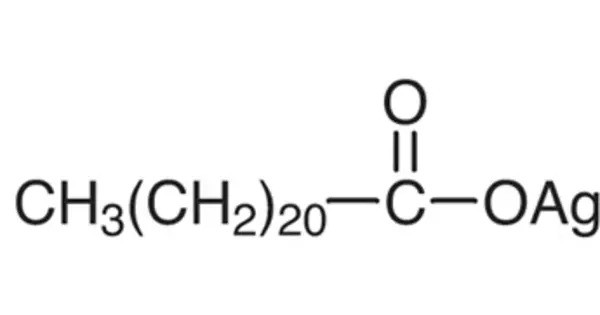
Silver behenate is a silver salt of the long-chain fatty acid behenic acid. It is a possible low-angle diffraction standard that was characterized using the powder diffraction technique. It is a light-brown or yellowish crystalline solid, known for its low solubility in water and its photosensitivity.
Due to its toxicity, especially from the arsenic component, silver arsenate is handled with great care and is not commonly used in large-scale industrial applications. However, it has limited use in analytical chemistry and materials research for studying silver and arsenate interactions. In environmental contexts, it may occur as a minor mineral phase in oxidized arsenic-bearing ores. Overall, silver arsenate is a chemically interesting but hazardous compound requiring controlled laboratory handling.
Properties
It is an inorganic compound composed of silver and arsenate ions. It appears as a yellow to reddish-brown crystalline solid and is known for its low solubility in water. The compound crystallizes in a monoclinic structure and has a molecular weight of approximately 463.54 g/mol.
Chemical formula: AgC22H43O2
Molar mass: 447.2287 g/mol
Chemically, it is moderately stable but can decompose when heated, producing silver oxide and arsenic oxides, which are toxic. It is photosensitive and can darken upon exposure to light. The compound’s melting point is not well defined due to decomposition at elevated temperatures.
Description
With the National Institute of Standards and Technology’s standard reference material silicon as an internal standard, the long spacing of silver behenate was accurately determined from the profile-fitted synchrotron diffraction peaks, with d001 = 58.380 (3) Å (5.8380(3) nm). This result was in agreement with that obtained from the CuKα pattern. The profile widths of the silver behenate peaks were found to be consistently larger than those of the silicon peaks, indicating significant line broadening for silver behenate. The average crystallite size along the long-spacing direction of silver behenate was estimated using the Scherrer equation, giving D(avg) = 900 (50) Å (85–95 nm).
Occurrences
Silver arsenate is rarely found naturally. It may occur as a minor secondary mineral in oxidation zones of silver-arsenic ore deposits. It can form through reactions between silver salts and arsenate-containing solutions in laboratory conditions.
Applications
- Analytical Chemistry: Used in qualitative analysis and precipitation reactions to detect arsenate ions.
- Photographic and Optical Materials: Studied for its photosensitive properties.
- Research Material: Used in materials science and chemistry research for studying ionic interactions and arsenate behavior.