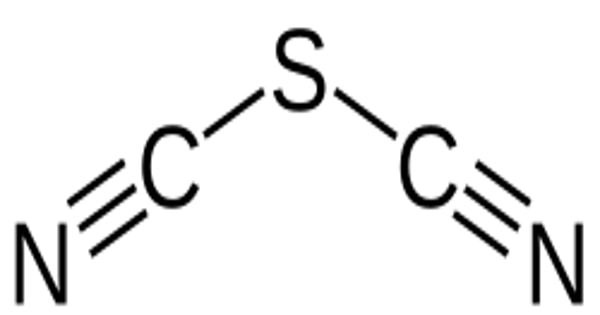
Sulfur dicyanide is a chemical compound consisting of one sulfur atom bonded to two cyanide groups. It is an inorganic compound with the formula S(CN)2. It is a colorless to pale yellow liquid with a pungent odor, known for being highly toxic and reactive. A white, slightly unstable solid, the compound is mainly of theoretical and fundamental interest given its simplicity.
Structurally, it features a linear arrangement of the cyanide groups attached to sulfur. It is the first member of the dicyanosulfanes Sx(CN)2, which includes thiocyanogen ((SCN)2) and higher polysulfanes up to S4(CN)2. According to X-ray crystallography, the molecule is planar, the SCN units are linear, with an S-C-S angle of 95.6°.
Properties
- Chemical formula: C2N2S
- Molar mass: 84.10 g·mol−1
- Appearance: white solid
- Density: 1.48 g/cm3
- Melting point: 62.3 °C (144.1 °F; 335.4 K)
- Sublimation conditions: 30–40 °C, 1 atm
Sulfur dicyanide begins to sublime at 30-40 °C and melts at 60 °C. Under an inert atmosphere, it slowly decomposes to a yellow polymer at room temperature with a rate increasing in temperature. The compound is unstable in acid, disproportionating to thiocyanate, cyanate, sulfate,and cyanide, and neutral moisture induces decomposition to thiocyanic and cyanic acids. Stable solutions are possible in many organic solvents.
Occurrences
Sulfur dicyanide is not commonly found in nature. It is primarily a synthetic compound used in laboratories and chemical industries.
Synthesis: Typically prepared by the reaction of sulfur halides (like sulfur dichloride, SCl₂) with cyanides (like KCN or NaCN) under controlled conditions.
Natural Occurrence: No significant natural sources are known. It is generally of interest in specialized chemical reactions rather than as a naturally occurring substance.
Applications
Sulfur dicyanide is mainly used as an intermediate in organic synthesis, particularly in the production of pesticides, dyes, and pharmaceuticals. It can also participate in reactions forming heterocyclic compounds. Although sulfur dicyanide is a niche compound, it has several notable applications:
- Organic Synthesis: Used as a reagent for producing thiocyanates and other sulfur–cyanide derivatives. Acts as a building block in the synthesis of heterocyclic compounds containing sulfur and nitrogen.
- Polymer Chemistry: Can be involved in the preparation of sulfur-containing polymers or cross-linking agents.
- Coordination Chemistry: The cyanide groups allow sulfur dicyanide to act as a ligand in the formation of coordination complexes with metals.
- Research and Laboratory Use: Employed in studies of sulfur–cyanide chemistry, particularly in mechanistic or theoretical research on multi-functional molecules.
Safety
Due to its reactivity, it must be handled under strict safety precautions, avoiding moisture, heat, and open flames. Exposure can lead to severe irritation of the eyes, skin, and respiratory system, and it is poisonous if ingested or inhaled. Its storage typically requires airtight containers under an inert atmosphere to prevent decomposition or hazardous reactions.