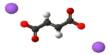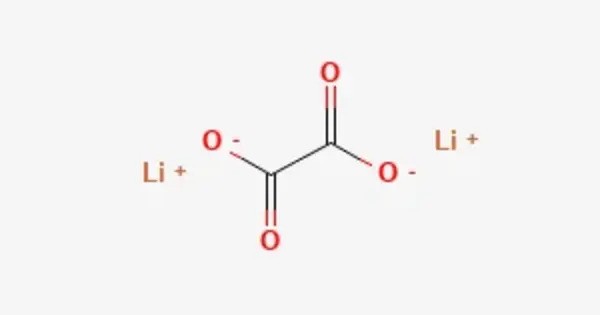
Lithium oxalate is an organic compound with the chemical formula Li2C2O4. It appears as a white crystalline solid that is moderately soluble in water and soluble in acids. It is a salt of lithium metal and oxalic acid. It consists of lithium cations Li+ and oxalate anions C2O2−4. Lithium oxalate is soluble in water and converts to lithium oxide when heated. It crystallizes typically in a monoclinic structure.
Lithium oxalate is mainly used as a precursor for producing lithium carbonate and lithium oxide through thermal decomposition. It is also of interest in materials science and electrochemistry, particularly as an additive or intermediate in lithium-ion battery research due to its potential to stabilize cathode materials and improve cycling performance.
Synthesis
One of the methods of synthesis is the reaction of direct neutralization of oxalic acid with lithium hydroxide:
2 LiOH + H2C2O4 → Li2C2O4 + 2 H2O
Properties
It appears as a white crystalline solid, soluble slightly in water but more soluble in acids. The compound has a molecular weight of 101.88 g/mol and a melting point around 470 °C, where it decomposes to lithium carbonate and carbon monoxide. It is thermally stable at room temperature but can react with strong acids or bases. Lithium oxalate is non-volatile and exhibits ionic bonding characteristics.
The compound crystallizes in the monoclinic system, cell parameters a = 3.400 Å, b = 5.156 Å, c = 9.055 Å, β = 95.60°, Z = 4.[
Lithium oxalate decomposes when heated at 410–500 °C (770–932 °F; 683–773 K):
- Li2C2O4 → Li2CO3 + CO
- Chemical formula: Li2C2O4
- Molar mass: 101.90 g·mol−1
- Appearance: Colorless crystalline solid
- Density: 2.12 g/cm3
- Solubility in water: 6.6 g per 100 g of water
Preparation
In laboratory chemistry, lithium oxalate is prepared by neutralizing oxalic acid with lithium hydroxide or lithium carbonate. Upon heating, it decomposes to form lithium carbonate (Li₂CO₃) and carbon monoxide (CO). The compound is stable under normal conditions but should be kept away from strong oxidizing agents and moisture.
Occurrences
Lithium oxalate does not occur naturally in significant quantities; it is typically synthesized in laboratories or industrially by reacting lithium carbonate or lithium hydroxide with oxalic acid. In some rare cases, oxalate minerals containing lithium may be found in pegmatitic rock formations, though they are uncommon. The compound is mainly utilized in material science, analytical chemistry, and battery precursor studies rather than being a naturally occurring mineral.
Applications
In pyrotechnics, the compound is used to color the flame red.
- Battery Technology – Lithium oxalate is used as a precursor material for lithium compounds in lithium-ion batteries. Upon decomposition, it forms lithium carbonate or lithium oxide, which are key components in battery cathodes and electrolytes.
- Analytical Chemistry – It serves as a standard reagent in analytical and laboratory chemistry for the preparation of lithium-based solutions and for precipitation or titration experiments.
- Material Synthesis – Used in the synthesis of lithium ceramics and glass materials, providing lithium content with controlled thermal decomposition behavior.
- Catalysis and Research – It is used in experimental catalysis, especially where controlled release of lithium ions or carbon dioxide (on heating) is advantageous.