Actinium oxyfluoride is an inorganic compound, with the chemical formula AcOF. It is radioactive. It crystallises in a calcium fluoride structure. It is a radioactive solid, primarily studied in the context of actinide chemistry due to actinium’s position as the first element in the actinide series. The compound contains actinium in the +3 oxidation state, along with oxygen and fluorine ions. It was first synthesized in the 1960s as part of research into actinide oxyhalides, with structural determinations confirming its similarity to lanthanide analogs like LaOF.
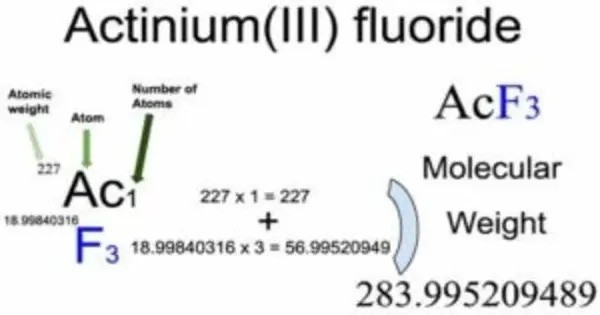
It can be obtained by reacting actinium fluoride with ammonia and water:
AcF3 + 2 NH3 + H2O → AcOF + 2 NH4F[α]
The reaction proceeds completely at 1200 °C, and unreacted AcF3 will remain at lower temperatures.
Properties
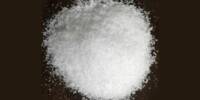
Actinium oxyfluoride appears as a white to off-white solid with high thermal stability. It is insoluble in water and common organic solvents, and exhibits no phase transitions below its decomposition temperature (above 1200°C). Its density is 8.28 g/cm³, and it has negligible vapor pressure below 1000°C.
- Chemical formula: AcOF
- Molar mass: 262.03 g·mol−1
- Appearance: solid
- Density: 8.280 g·cm−1
- Crystal structure: cubic
Synthesis
The primary synthesis method involves a high-temperature reaction of actinium trifluoride (AcF₃) with ammonia (NH₃) and water vapor under an inert atmosphere:
AcF₃ + 2 NH₃ + H₂O → AcOF + 2 NH₄F
This reaction occurs at 900–1200°C, proceeding completely at 1200°C, though unreacted AcF₃ may remain at lower temperatures. An alternative method is the reaction of actinium metal with O₂ and HF at controlled pressures. Purification typically involves washing with anhydrous ammonia. Synthesis requires specialized handling due to the radioactivity of actinium (primarily Ac-227, half-life 21.77 years).
Applications
Due to its radioactivity and the scarcity of actinium, AcOF has no commercial applications. It is used primarily in research:
- As a model system for studying trivalent actinides and comparisons with lanthanide analogs.
- Precursor for actinium oxide synthesis with controlled morphology.
- In structural studies of actinide chemistry.
- Potential matrix for nuclear waste immobilization (though limited by radioactivity).
- For ion transport studies in solid electrolytes, leveraging its fluorite structure for F⁻ conduction at high temperatures.
Safety and Handling
Actinium oxyfluoride is highly radioactive, emitting alpha particles from Ac-227 (half-life 21.77 years) and its decay chain, which includes beta and gamma emitters. It must be handled in specialized facilities with double-walled vessels, negative pressure ventilation, and radiation monitoring. Metallic impurities should be minimized (<50 ppm non-actinide metals), and radiochemical purity maintained to avoid excess daughter nuclides. As a fluoride compound, it poses additional risks of HF release upon decomposition. Standard precautions for radioactive materials apply, including shielding, dosimetry, and waste disposal protocols.