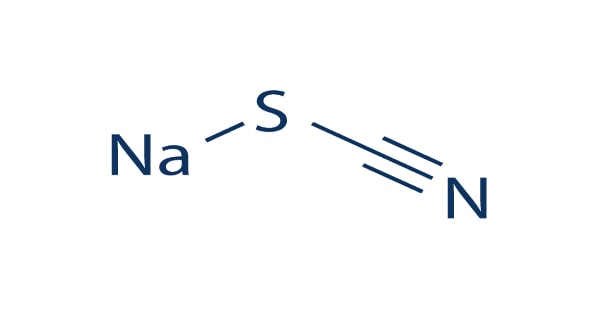
Sodium thiocyanate (NaSCN) is an inorganic chemical compound made of sodium, sulfur, carbon, and nitrogen. It appears as a white, crystalline solid and is highly soluble in water. This colorless deliquescent salt is one of the main sources of the thiocyanate anion. As such, it is used as a precursor for the synthesis of pharmaceuticals and other specialty chemicals.
Sodium thiocyanate is commonly used in laboratories, photography, textile dyeing, and chemical manufacturing. In medicine and biochemistry, it is used in diagnostic tests and as a reagent for studying enzymes and proteins. It also plays a role in metal processing, corrosion inhibition, and the production of pesticides and pharmaceuticals.
When dissolved, it produces thiocyanate ions, which can interact with iron to form a deep red color—often used in chemical analysis. Although useful, sodium thiocyanate can be harmful if ingested in large amounts, as it may affect the nervous system and thyroid function. Proper handling and storage are therefore important. Thiocyanate salts are typically prepared by the reaction of cyanide with elemental sulfur:
8 NaCN + S8 → 8 NaSCN
Sodium thiocyanate crystallizes in an orthorhombic cell. Each Na+ center is surrounded by three sulfur and three nitrogen ligands provided by the triatomic thiocyanate anion. It is commonly used in the laboratory as a test for the presence of Fe3+ ions.
Properties
- Chemical formula: NaSCN
- Molar mass: 81.072 g/mol
- Appearance: deliquescent colorless crystals
- Density: 1.735 g/cm3
- Melting point: 287 °C (549 °F; 560 K)
- Boiling point: 307 °C (585 °F; 580 K) decomposes
- Solubility in water: 139 g/100 mL (21 °C), 225 g/100 mL (100 °C)
- Solubility: soluble in acetone, alcohols, ammonia, SO2
Occurrences
Sodium thiocyanate is rarely found naturally. It is mostly manufactured synthetically, but thiocyanates as a group are present in nature:
Natural Sources:
Found in some plants (especially in cruciferous vegetables like cabbage, broccoli) as a product of cyanogenic glycosides metabolism.
Present in soil and water in trace amounts due to microbial action on cyanide-containing compounds.
Industrial Preparation:
Produced by reacting sodium cyanide (NaCN) with sulfur or carbon disulfide (CS₂):
NaCN+S → NaSCN
Also obtained by neutralizing thiocyanic acid (HSCN) with sodium hydroxide.
Applications
Sodium thiocyanate has a wide variety of applications across industry, chemistry, and medicine:
Chemical Industry:
- Used as a precursor to other thiocyanates and in the preparation of pesticides, dyes, and rubber chemicals.
- Acts as a complexing agent for metal ions in analytical chemistry.
Analytical Chemistry: Forms colored complexes with iron(III) ions, producing red ferric thiocyanate, used as a qualitative test for iron.
Pharmaceuticals:
Historically used in small amounts as an antihypertensive agent (though largely replaced by modern drugs).
Electroplating and Metallurgy: Used as a fluxing agent and for metal cleaning.
Organic Synthesis: Acts as a thiocyanating agent, introducing the –SCN group into organic molecules.
Laboratory Uses: Used in photographic chemicals and as a reagent in research chemistry.