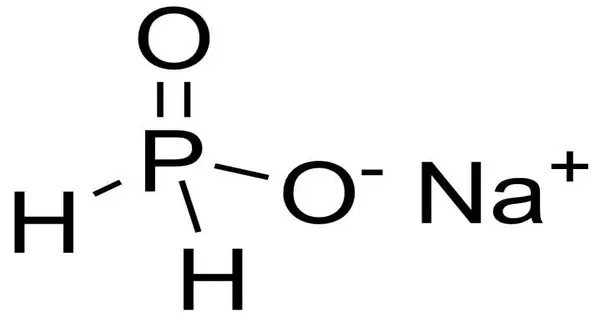
Sodium hypophosphite (NaPO2H2, also known as sodium phosphinate) is the sodium salt of hypophosphorous acid and is often encountered as the monohydrate, NaPO2H2·H2O. It is a valuable industrial chemical, mainly used in metal finishing, with notable reducing capabilities and specific handling requirements due to its reactive nature. It is a solid at room temperature, appearing as odorless white crystals. It is soluble in water, and easily absorbs moisture from the air.
Sodium hypophosphite should be kept in a cool, dry place, isolated from oxidizing materials. It decomposes into phosphine which is irritating to the respiratory tract and disodium phosphate.
2 NaH2PO2 → PH3 + Na2HPO4
One of its main applications is in electroless nickel plating, where it reduces nickel ions to metallic nickel without the need for an external electrical current. This process is widely used in electronics and corrosion-resistant coatings.
Properties
It is a white, crystalline, water-soluble salt primarily used as a reducing agent. It appears odorless and is typically stable under normal storage conditions but decomposes upon heating, releasing phosphine gas (PH₃), which is toxic and flammable.
- Chemical formula: NaPO2H2
- Molar mass: 87.98 g/mol (anhydrous), 105.99 g/mol (monohydrate)
- Appearance: white solid
- Density: 0.8 g/cm3 (monohydrate)
- Melting point: 310 °C (590 °F; 583 K) (monohydrate)
- Solubility in water: soluble
- Solubility: Ethanol, Acetic acid, Ethylene glycol, Propylene glycol
Chemically, sodium hypophosphite is the sodium salt of hypophosphorous acid (H₃PO₂) and exists in a monobasic form, meaning it donates one proton. It has mild antimicrobial properties and is occasionally used as a preservative in food and pharmaceuticals, though such use is limited due to regulatory and safety concerns.
Natural Occurrence
Synthetic Compound: Sodium hypophosphite does not occur naturally in significant amounts.
It is manufactured industrially via the neutralization of hypophosphorous acid (H₃PO₂) with sodium hydroxide (NaOH):
𝐻3𝑃𝑂2+𝑁𝑎𝑂𝐻 → 𝑁𝑎𝐻2𝑃𝑂2 + 𝐻2𝑂
Uses
Like other hypophosphites, sodium hypophosphite can reduce metal ions back into base metal. This forms the basis for electroless nickel plating (Ni-P), which is its main industrial application. With this method, a durable nickel-phosphorus film can coat objects with irregular surfaces, such as in avionics, aviation and the petroleum field.
Sodium hypophosphite is capable of reducing nickel ions in solution to metallic nickel on metal substrates as well as on plastic substrates. The latter requires that the substrate is activated with fine particles of palladium. The resulting nickel deposit contains up to 15% phosphorus.
Safety and Handling
- Toxicity: Can release phosphine gas (PH₃) when heated or in contact with acids, which is highly toxic and flammable.
- Storage: Should be stored in a cool, dry place, away from acids and ignition sources.
- Hazards: Irritant to skin, eyes, and respiratory tract.