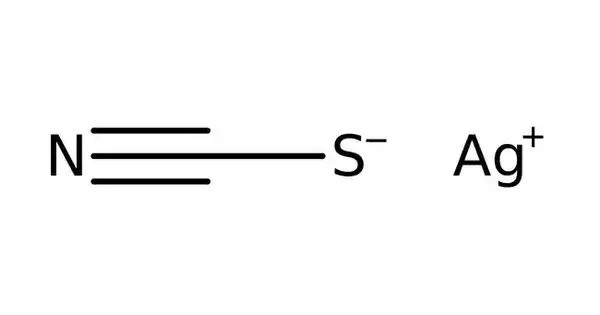
Silver thiocyanate is the silver salt of thiocyanic acid with the formula AgSCN. It is an inorganic compound composed of silver (Ag⁺) and thiocyanate (SCN⁻) ions. It appears as a white to grayish powder and is poorly soluble in water. It is very commonly used in the synthesis of silver nanoparticles. Additionally, studies have found silver nanoparticles to be present in saliva present during the entire digestive process of silver nitrate. It is known for its distinctive chemical properties and specific applications in analytical chemistry and materials science.
Properties
Silver thiocyanate appears as a white crystalline powder. It is slightly soluble in water, with a solubility of 1.68 x 10⁻⁴ g/L. It is insoluble in ethanol, acetone, and acid. It is photosensitive and may decompose or darken under light.
- Chemical formula: AgSCN
- Appearance: Colorless crystals
- Odor: Odorless
- Melting point: 170 °C (338 °F; 443 K), decomposes
- Solubility in water: 0.14 mg/L (19.96 °C), 6.68 mg/L (100 °C)
- Solubility product (Ksp): 1.03·10−12
- Solubility: Insoluble in acids (reacts) except when concentrated, acetates, aq. nitrates
- Solubility in silver nitrate: 43.2 mg/L (25.2 °C, 3 nAgNO3/H2O)
Structure
AgSCN is monoclinic with 8 molecules per unit cell. Each SCN− group has an almost linear molecular geometry, with bond angle 179.6(5)°. Weak Ag—Ag interactions of length 0.3249(2) nm to 0.3338(2) nm are present in the structure.
Preparation
Silver thiocyanate is light-sensitive and can darken upon exposure due to silver’s photosensitivity. It forms a monoclinic crystal structure and is typically prepared by reacting a soluble silver salt, like silver nitrate (AgNO₃), with a thiocyanate salt (e.g., potassium thiocyanate, KSCN), resulting in a white precipitate:
AgNO₃ + KSCN → AgSCN↓ + KNO₃
AgSCN is used in analytical chemistry, especially in qualitative analysis for detecting silver or thiocyanate ions. It’s also employed in photographic materials, electroplating, and as a precursor in coordination chemistry.
Due to the presence of silver, it can exhibit mild antimicrobial properties. However, it is relatively stable under standard conditions but should be stored away from light to prevent decomposition.
Production
Solution reaction
Silver thiocyanate has been commonly produced by the reaction between silver nitrate and potassium thiocyanate.
AgNO3 + KSCN → KNO3 + AgSCN
Ion-exchange route
Silver thiocyanate may be formed via an ion exchange reaction. In this double displacement reaction, silver nitrate and ammonium thiocyanate are dissolved in distilled water to produce silver thiocyanate and ammonium nitrate.
AgNO3 + NH4SCN → NH4NO3 + AgSCN
Additionally, silver thiocyanate can be formed through the double displacement reaction between ammonium thiocyanate and silver chloride to form a precipitate of silver thiocyanate.
AgCl + NH4SCN → NH4Cl + AgSCN
Occurrence
Silver thiocyanate does not occur naturally in the Earth’s crust. It is a synthetic compound, typically produced in laboratories or industrial settings.
Laboratory Preparation
It is prepared by precipitation:
AgNO3(aq)+KSCN(aq)→AgSCN(s)+KNO3(aq)
This forms a white precipitate of silver thiocyanate, a reaction used in qualitative analysis.
Uses
The most common use of silver thiocyanate is as a silver nanoparticle. Silver thiocyanate nanoparticles have been found in saliva throughout the entire artificial digestion of silver nitrate. The nanoparticles can also be used as good ion conductors.
Silver thiocyanate has also been used to absorb uv-visible light at values less than 500 nm. At longer wavelengths, silver thiocyanate has been found to have good photocatalytic properties.
Safety
Safety-wise, silver thiocyanate should be handled with care. It can be harmful if ingested or inhaled, and skin or eye contact should be avoided. Proper personal protective equipment is recommended during handling.