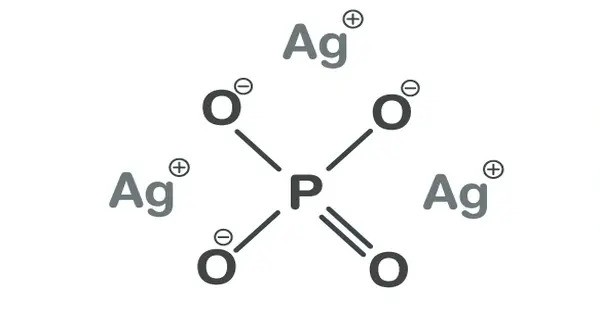
Silver phosphate or silver orthophosphate is a light sensitive, yellow, water-insoluble chemical compound composed of silver and phosphate ions of formula Ag3PO4. It is an inorganic compound composed of silver and phosphate ions. It appears as a bright yellow, crystalline solid and is sparingly soluble in water but more soluble in acids and ammonia solutions. Silver phosphate is sensitive to light and can slowly darken due to the reduction of silver ions, a property common to many silver compounds.
Additionally, silver phosphate finds limited use in antibacterial coatings and research applications related to photoelectrochemical cells. However, its practical use is constrained by high cost and photosensitivity. Overall, silver phosphate is valued mainly for its chemical reactivity and advanced research applications rather than large-scale industrial use.
Properties
It has a molar mass of about 418.6 g/mol and is practically insoluble in water, though it dissolves in dilute nitric acid and ammonia solutions. Ag₃PO₄ is stable under normal conditions but decomposes on strong heating. One of its notable features is its strong photosensitivity and excellent photocatalytic activity under visible light, arising from its suitable band gap.
- Chemical formula: Ag3PO4
- Molar mass: 418.574 g/mol
- Appearance: Translucent yellow becomes opaque or discolors when impure.
- Odor: odorless
- Density: 6.370 g/cm3
- Melting point: 849 °C (1,560 °F; 1,122 K)
- Solubility in water: 0.00065 g/100 mL
- Solubility product (Ksp): 8.89×10⁻¹⁷
Silver phosphate is widely studied for its photocatalytic activity, especially under visible light. It is effective in degrading organic pollutants and dyes in wastewater, making it a promising material for environmental remediation. In analytical chemistry, it is used as a reagent for detecting phosphate ions and for gravimetric analysis.
Preparation
It is typically prepared by a precipitation reaction between a soluble silver salt, such as silver nitrate, and a soluble phosphate, like sodium phosphate. The compound crystallizes in a cubic structure and has a relatively high density. Due to the presence of silver ions, Ag₃PO₄ exhibits notable antimicrobial properties.
Synthesis, and reactions
Silver phosphate is formed as a yellow solid precipitate by the reaction between a soluble silver salt, such as silver nitrate, with a soluble orthophosphate. Its solubility product is 8.89×10⁻¹⁷ mol4·dm−2. The precipitation reaction is analytically significant and can be used in qualitative or quantitative analysis.
This compound dissolves in aqueous ammonia. Large crystals of silver phosphate form upon gradual evaporation of such ammoniacal solutions. Its structure has been confirmed by X-ray crystallography.
Occurrences
Silver phosphate does not occur widely as a natural mineral. It is mainly produced synthetically by precipitation reactions, typically by mixing a soluble silver salt (such as silver nitrate) with a soluble phosphate source. In nature, it may form in trace amounts in silver-bearing environments where phosphate ions are present, but such occurrences are rare and not of economic significance.
Applications
Silver phosphate is widely studied and used as a photocatalyst for the degradation of organic pollutants and dyes in wastewater under visible light. It is also employed in analytical chemistry for the qualitative and quantitative determination of phosphate ions. In addition, Ag₃PO₄ has applications in antimicrobial research, benefiting from silver’s biocidal properties, and is used in laboratory research related to photocatalysis, environmental remediation, and materials science.
- The precipitation of silver phosphate is useful in traditional analytical chemistry. Precipitation of silver phosphate is also used in silver staining of biological materials (after reduction to silver metal) – as a magnifying agent for phosphate.
- Silver phosphate also found use in early photography as a light sensitive agent.
- Silver phosphate exhibits antibacterial properties.