Rubidium triiodide is an inorganic compound with the chemical formula RbI3. It is composed of Rb+ and I−3. It appears as a dark, crystalline solid that is highly sensitive to moisture and light. This compound is part of the alkali metal polyiodides family, where rubidium cations (Rb⁺) are surrounded by complex triiodide (I₃⁻) anions, which consist of three covalently bonded iodine atoms forming a linear structure.
Rubidium triiodide is typically formed by reacting rubidium iodide (RbI) with elemental iodine in an appropriate solvent. It is soluble in polar solvents like water and alcohol, though it may partially decompose upon heating or exposure to air, releasing iodine vapors. The compound’s color and properties are influenced by the delocalization of electrons within the triiodide ion, which gives it a characteristic deep brown or black appearance.
Preparation
Rubidium triiodide can be obtained by heating rubidium iodide and iodine in aqueous solution:
RbI + I2 → RbI3
Rubidium triiodide is mainly studied for its structural and chemical behavior in solid-state and coordination chemistry. It serves as a model compound for understanding halogen bonding and the formation of polyiodide networks. While it has limited direct industrial use, it plays a role in academic research, particularly in studying ionic bonding and charge transfer in alkali metal halides.
Prperties
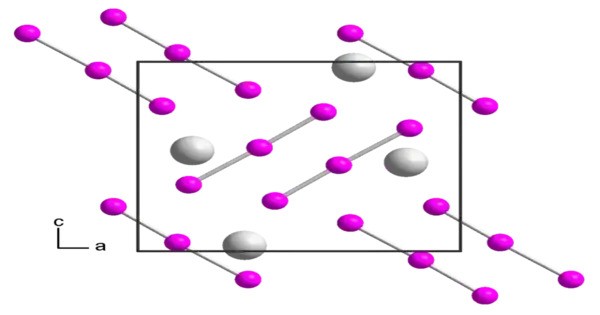
Rubidium triiodide is an orthorhombic black crystal, isomorphic to caesium triiodide, with space group Pnma, unit cell parameters a = 1090.8 pm, b = 665.5 pm, c = 971.1 pm. Upon heating to 270 °C, the rubidium triiodide decomposes into rubidium iodide and elemental iodine. It is soluble in ethanol and decomposes in ether.
It t is a dark violet or nearly black crystalline solid, often showing a metallic luster. The compound is formed by the combination of rubidium iodide (RbI) and elemental iodine (I₂), typically in a 1:1 molar ratio. It is sensitive to moisture and heat, decomposing upon heating to release iodine vapor and form rubidium iodide. RbI₃ is highly soluble in polar solvents like water and ethanol, and it tends to dissociate into Rb⁺ and polyiodide ions (I₃⁻) in solution. Structurally, it contains linear triiodide (I₃⁻) anions, stabilized by the large rubidium cation.
Reactions
It has long been believed that rubidium triiodide reacts further with iodine to form RbI7 and RbI9, but this has been refuted by recent studies.
Occurrences
Rubidium triiodide is a synthetic compound, not found naturally. It is produced in laboratories by reacting rubidium iodide with iodine crystals under controlled conditions. Such polyiodide compounds are used in chemical research, spectroscopy, and materials science, particularly for studying charge transfer complexes and iodine chemistry.
Applications
- Inorganic and Solid-State Chemistry: It is studied as part of the family of polyiodide compounds, which exhibit interesting bonding and electronic properties. Researchers use it to understand metal–iodine interactions and the behavior of large polyiodide ions.
- Precursor in Material Synthesis: It can serve as a precursor for preparing other rubidium–iodine compounds, especially in the synthesis of materials used in electronics or optics, where controlled iodine content is required.
- Spectroscopic and Crystallographic Studies: Due to its complex crystal structure, RbI₃ is often used in crystallographic and vibrational spectroscopy studies to explore ionic bonding, molecular geometry, and charge distribution.
- Research on Ionic Conductors: Some studies investigate rubidium triiodide as part of solid electrolytes or mixed halide systems for potential use in ion-conducting materials, relevant to advanced battery or sensor technologies.