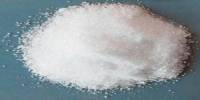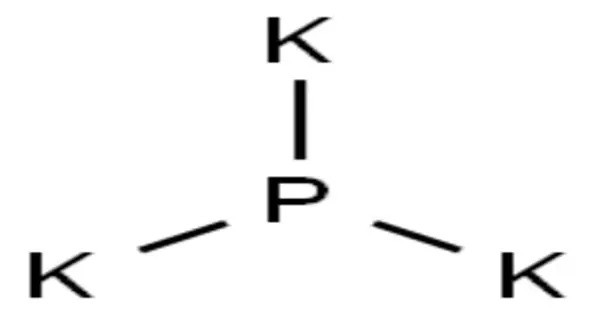
Potassium phosphide is an inorganic semiconductor compound with the formula K3P. It appears as a green crystalline solid or powder. This compound crystallizes in a structure similar to sodium phosphide (Na₃P) and is considered an ionic compound containing potassium cations (K⁺) and phosphide anions (P³⁻). It reacts violently with water (even on contact with air) and is toxic via ingestion, inhalation and skin absorption. It has a hexagonal structure.
Preparation
Potassium phosphide is typically prepared by the direct reaction of elemental potassium with phosphorus under an inert atmosphere due to its sensitivity to moisture. When it comes into contact with water, it reacts vigorously, releasing phosphine gas (PH₃), which is highly toxic and flammable. Because of this, the compound must be handled in dry, oxygen-free environments.
Properties
Potassium phosphide is an inorganic compound with the chemical formula K₃P. It appears as a dark gray or black crystalline solid. The compound is highly reactive and unstable in the presence of moisture or air, as it reacts vigorously with water to release phosphine gas (PH₃), which is toxic and flammable.
- Chemical formula: K3P
- Molar mass: 148.269 g mol−1
- Appearance: Green crystalline solid or powder
Potassium phosphide has strong reducing properties and can ignite spontaneously in humid air due to the phosphine generation. It is soluble in water only through decomposition and must be handled under dry, inert conditions such as nitrogen or argon.
Synthesis
Potassium phosphide can be synthesised by a reaction under controlled conditions starting from the two elements. Simply fusing potassium and phorsphorus does not yield pure K3P:
12 K + P4 → 4 K3P
Occurrences
Potassium phosphide does not occur naturally. It is synthesized artificially by direct combination of potassium metal and phosphorus at elevated temperatures. Because of its instability and hazardous nature, it is primarily used for research purposes and as an intermediate in the preparation of other phosphorus-containing compounds.
Applications
Potassium phosphide is used in high power, high frequency applications and also in laser diodes. It is mainly used in research laboratories and in certain chemical syntheses where phosphide ions are required. Industrial applications are limited due to its instability and hazardous nature. Potassium phosphide serves as a precursor for producing phosphine and other phosphorus-containing compounds.
Safety
In terms of safety, potassium phosphide is classified as dangerous and corrosive, capable of causing burns upon contact. Its reactivity and toxicity necessitate strict safety precautions, including storage under inert gas and avoidance of contact with water or acids.