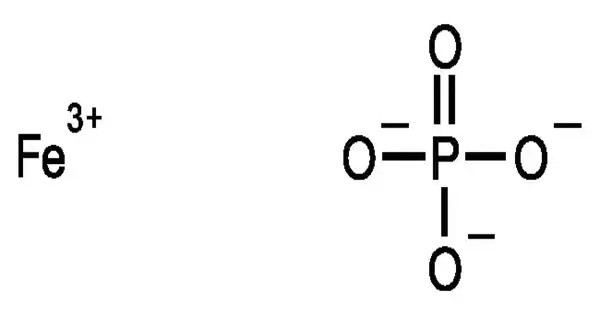
Iron(III) phosphate or ferric phosphate is an inorganic compound with the formula FePO4. Four polymorphs of anhydrous FePO4 are known. It typically appears as a grayish-white or light yellow solid that is insoluble in water but soluble in acids. Additionally, two polymorphs of the dihydrate FePO4·(H2O)2 are known. These polymorphs have attracted interest as potential cathode materials in batteries. In this compound, iron exists in the +3 oxidation state, bonded with phosphate anions (PO₄³⁻).
Iron(III) phosphate naturally occurs as the mineral strengite, often found in soils and sedimentary deposits where iron and phosphate interact under oxidizing conditions. It has a crystalline structure and exhibits both amorphous and hydrated forms.
Properties
It usually appears as a grayish-white to yellowish solid and is insoluble in water. The compound exists in several hydrated forms, such as FePO₄·2H₂O, and has a molar mass of about 150.82 g/mol in its anhydrous state. It is thermally stable and non-combustible, with a high melting point and low solubility in acids and bases.
- Chemical formula: FePO4
- Molar mass: 150.815 g/mol (anhydrous)
- Appearance: yellow-brown solid
- Density: 3.056 g/cm3 (anhydrous), 2.87 g/cm3 (20 °C, dihydrate)
- Melting point: 250 °C (482 °F; 523 K) (dihydrate) decomposes
- Solubility in water: anhydrous: insoluble; dihydrate: 0.642 g/100 mL (100 °C)
Structure
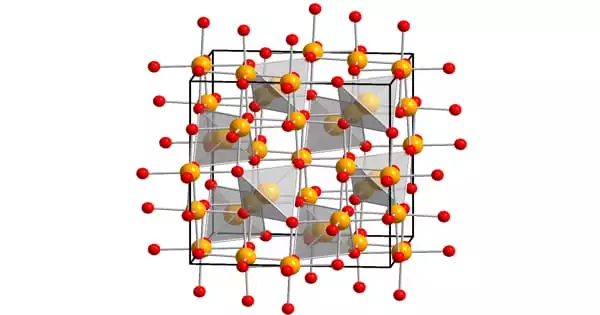
The most common form of FePO4 adopts the structure of α-quartz. As such the material consists of tetrahedral Fe(III) and phosphate sites. As such the P and Fe have tetrahedral molecular geometry. At high pressures, a phase change occurs to a more dense structure with octahedral Fe centres. Two orthorhombic structures and a monoclinic phase are also known. In the two polymorphs of the dihydrate, the Fe centre is octahedral with two mutually cis water ligands.
Occurrences
Iron(III) phosphate naturally occurs as the mineral strengite, typically found in phosphate-rich soils, pegmatites, and sedimentary rocks. It forms under oxidizing conditions where iron and phosphate ions coexist. It is also found in biological systems, playing a role in plant nutrition as a source of both iron and phosphorus. Industrially, it can be synthesized by reacting ferric salts with phosphate solutions.
Uses
Iron(III) phosphate can be used in steel and metal manufacturing processes. When bonded to a metal surface, iron phosphate prevents further oxidation of the metal. Industrially, it is used in the production of lithium iron phosphate (LiFePO₄), a key material for rechargeable lithium-ion batteries. It is also employed as a fertilizer additive to supply essential iron and phosphorus nutrients to plants. Additionally, it serves as a corrosion inhibitor, ceramic glaze component, and pigment in paints.
Iron phosphate coatings are commonly used in preparation for painting or powder coating, in order to increase adhesion to the iron or steel substrate, and prevent corrosion, which can cause premature failure of subsequent coating processes.
In biological and environmental contexts, iron(III) phosphate plays a role in nutrient cycling and soil chemistry. It helps regulate phosphate availability and immobilizes excess phosphate, thus preventing water pollution. Though generally considered non-toxic, excessive ingestion or exposure may cause irritation or mild health effects. Its stability and eco-friendly properties make it useful in sustainable technologies.