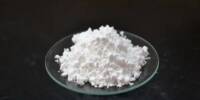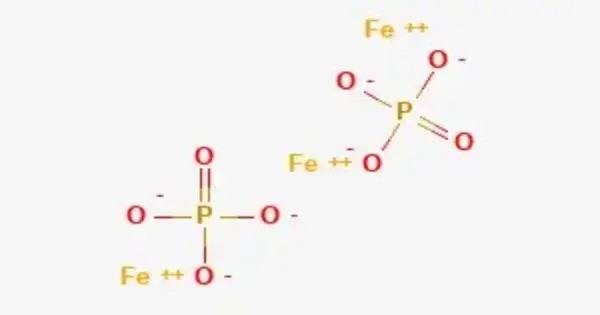
Iron(II) phosphate, also ferrous phosphate, Fe3(PO4)2, is an iron salt of phosphoric acid. It appears as a bluish-green or grayish crystalline solid and is poorly soluble in water. The compound consists of divalent iron (Fe²⁺) cations and phosphate (PO₄³⁻) anions, forming a stable, ionic lattice.
This compound is used in various applications, including fertilizers, as a source of iron and phosphorus, and in ceramics, pigments, and corrosion-resistant coatings. In biological contexts, iron and phosphate are both essential nutrients — iron for oxygen transport and phosphate for energy metabolism — though ferrous phosphate itself is not highly bioavailable.
Natural occurrences
The mineral vivianite is a naturally occurring form of hydrated iron(II) phosphate. It is often found in mineral forms, such as vivianite, which occurs in soil, sedimentary rocks, and bog environments under reducing conditions where iron remains in the ferrous state. Upon exposure to air, it can oxidize to iron(III) phosphate, changing color from blue-green to brown.
Production
It can be formed by the reaction of ferrous hydroxide with phosphoric acid to produce hydrated iron(II) phosphate.
Properties
It typically appears as a bluish-green crystalline solid, insoluble in water but slightly soluble in acids. The compound is stable under normal conditions but can oxidize in air, converting Fe²⁺ to Fe³⁺, forming iron(III) phosphate. Its molar mass is approximately 357.48 g/mol, and it has a high melting point, indicating strong ionic bonding between iron and phosphate ions. It is non-volatile and thermally stable up to decomposition.
- Chemical formula: Fe3(PO4)2
- Appearance: brown powder
- Density: 2.61 g/cm3 (octahydrate)
- Melting point: 180 °C (356 °F; 453 K) (octahydrate) decomposes
- Solubility in water: insoluble
Chemically, Iron(II) phosphate is stable under anaerobic conditions but decomposes or oxidizes when exposed to oxygen or acids. It is non-toxic and considered environmentally safe, contributing to soil mineral balance and participating in natural geochemical cycling processes.
Applications
- Fertilizers: Iron(II) phosphate is used as a source of iron and phosphorus in agricultural fertilizers. It helps correct iron deficiency in soils and promotes healthy plant growth, especially in alkaline conditions where iron availability is low.
- Pigments and Coatings: It is used as a pigment in paints and coatings for its corrosion-resistant properties and earthy coloration. Iron phosphates can also enhance the adhesion of coatings to metal surfaces.
- Battery Materials: Iron(II) phosphate, and more commonly its oxidized form lithium iron phosphate (LiFePO₄), serve as components in rechargeable lithium-ion batteries due to their stability, safety, and long life cycle.
- Catalysts: It can act as a catalyst in certain chemical reactions, including oxidation and reduction processes in industrial applications.
- Water Treatment: Iron(II) phosphate may be applied in wastewater treatment to remove phosphates, thus preventing eutrophication in aquatic environments.