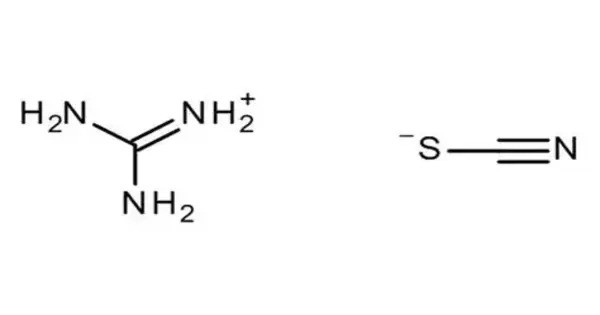
Guanidinium thiocyanate (GTC) or guanidinium isothiocyanate (GITC) is a colorless-to-white crystalline chaotropic agent highly soluble in water (1420 g/L at 20 °C). It is a chemical compound used as a general protein denaturant, being a chaotropic agent, although it is most commonly used as a nucleic acid protector in the extraction of DNA and RNA from cells.
GITC may also be recognized as guanidine thiocyanate. This is because guanidinium is the conjugate acid of guanidine and is called the guanidinium cation, [CH6N3]+. It combines the strong denaturant guanidinium cation (Gdm⁺) with thiocyanate anion (SCN⁻), making it one of the most powerful protein denaturants known. Widely used in molecular biology labs despite toxicity because no milder reagent matches its RNase inactivation efficiency.
Properties
- Chemical formula: C2H6N4S
- Molar mass: 118.16 g·mol−1
- Appearance: White to slightly off-white crystalline powder
- Melting point: 118–122 °C (decomposes before melting in some sources)
- Solubility: Highly soluble in water (~1400 g/L at 20 °C); also soluble in ethanol, slightly soluble in acetone
- Density: ~1.4 g/cm³
- pH (aqueous solution): Strongly acidic (4–6 M solutions ~pH 4–5)
- Stability: Hygroscopic; stable when dry; aqueous solutions slowly decompose releasing H₂S and ammonia
Preparation
This substance can be prepared by reacting guanidinium carbonate with ammonium sulfate or ammonium thiocyanate under heat. Another method is the pyrolysis of ammonium thiocyanate or thiourea at 180°C.
Uses
Guanidinium thiocyanate can be used to deactivate a virus, such as the influenza virus that caused the 1918 “Spanish flu”, so that it can be studied safely.
Guanidinium thiocyanate is also used to lyse cells and virus particles in RNA and DNA extractions, where its function, in addition to its lysing action, is to prevent activity of RNase enzymes and DNase enzymes by denaturing them. These enzymes would otherwise damage the extract.
Safety and Handling
- Highly toxic (oral LD₅₀ rat ≈ 300–600 mg/kg)
- Contact with acids liberates toxic hydrogen cyanide (HCN) and hydrogen sulfide (H₂S) gases
- Strong irritant to eyes, skin, and respiratory tract
- Usually handled as 4–6 M aqueous solutions with β-mercaptoethanol or DTT added as reducing agent and further RNase inhibitor