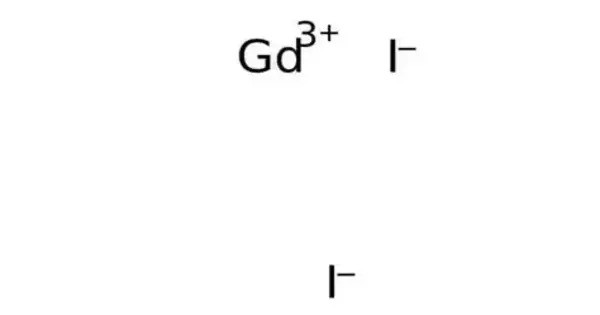
Gadolinium iodate is an inorganic compound with the chemical formula Gd(IO3)3. It is produced by reacting gadolinium metal with periodic acid at 180 °C. It is composed of the rare-earth metal gadolinium (Gd) and the iodate anion (IO₃⁻). Its solubility in water is 0.893±0.002 (25 °C, 103 mol·dm−3). Adding ethanol or methanol to water will reduce the solubility. It typically appears as a white, crystalline solid and is valued for its nonlinear optical properties, magnetism, and stability.
Properties
- Chemical formula: Gd(IO3)3
- Molar mass: 681.96
- Appearance: colourless crystals
Preparation
Common synthesis methods include:
1. Reaction of Gadolinium Oxide with Iodic Acid
Gd2O3+6HIO3→2Gd(IO3)3+3H2O
2. Precipitation Method
Mixing soluble gadolinium salts (e.g., GdCl₃) with sodium iodate:
GdCl3+3NaIO3→Gd(IO3)3+3NaCl
Hydrothermal crystal growth is used to produce larger, high-quality NLO crystals.
Occurrences
Natural Occurrence
- Does not occur naturally in minerals
- Iodates exist in nature (e.g., lautarite), but gadolinium iodate is strictly synthetic
Laboratory Preparation
- Gadolinium iodate is typically prepared by:
- Dissolving gadolinium oxide (Gd₂O₃) or gadolinium nitrate in dilute acid
- Reacting with iodic acid (HIO₃)
- Allowing the iodate crystals to precipitate as the solution cools or evaporates