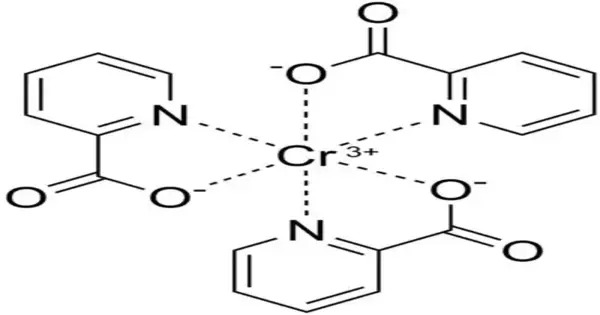
Chromium(III) picolinate (also trivalent chromium) is a chemical compound with the formula Cr(C5H4N(CO2))3, commonly abbreviated as CrPic3. It appears as a pink to reddish crystalline powder and is only slightly soluble in water but more soluble in organic solvents. It is a bright-red coordination compound derived from chromium(III) and picolinic acid. This compound is best known for its use as a dietary supplement, as chromium(III) is an essential trace element involved in carbohydrate, lipid, and protein metabolism.
Chromium picolinate is believed to enhance insulin action by improving glucose uptake in cells, which has led to its use in managing blood sugar levels and supporting weight control, although clinical evidence remains mixed. Chemically, chromium is present in the stable +3 oxidation state, which is far less toxic than hexavalent chromium. Beyond nutrition, chromium(III) picolinate is mainly studied in biochemical and pharmacological research rather than industrial applications.
Properties
Chromium(III) picolinate is a coordination compound with the formula Cr(C₆H₄NO₂)₃, where trivalent chromium is chelated by three picolinic acid ligands. It usually appears as a reddish-purple to dark violet crystalline powder. The compound is sparingly soluble in water but shows better solubility in organic solvents. It is relatively stable under normal conditions, non-volatile, and has a moderate molecular weight. Chromium is present in the +3 oxidation state, which is considered the biologically essential and less toxic form of chromium compared to hexavalent chromium.
Occurrences
Chromium(III) picolinate does not occur naturally as a mineral. It is a synthetically produced compound, prepared by reacting chromium(III) salts (such as chromium chloride) with picolinic acid under controlled conditions. While the compound itself is synthetic, its components have natural origins: chromium(III) occurs naturally in trace amounts in foods like whole grains and vegetables, and picolinic acid is a natural metabolite of the amino acid tryptophan in the human body.
Trivalent chromium occurs naturally in many foods and is one of several forms of chromium sold as a dietary supplement intended to correct chromium deficiency. However, there is no evidence of chromium deficiency in healthy people and no medical symptoms of chromium deficiency exist. Supplementation with trivalent chromium does not prevent or treat obesity, impaired prediabetes condition, type 2 diabetes or metabolic syndrome, and is not considered effective for maintaining or losing body weight.
Although daily doses of trivalent chromium up to 1,000 μg are considered to be safe, some adverse effects have been reported, and there is no clinical evidence that chromium supplementation provides any health benefit.
Applications
Chromium(III) picolinate is mainly applied in the nutritional and health supplement sector due to its role in glucose metabolism. It is widely used as a dietary supplement to support insulin function, improve glucose tolerance, and help maintain normal blood sugar levels, particularly in individuals with impaired glucose metabolism or type-2 diabetes (under medical guidance).
In the weight-management and fitness industry, chromium(III) picolinate is included in formulations aimed at reducing carbohydrate cravings, enhancing lean muscle mass, and supporting fat metabolism.