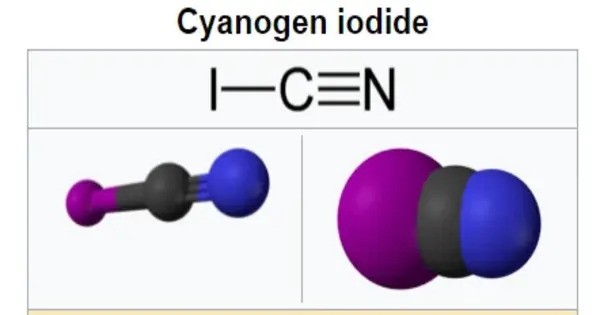
Cyanogen iodide or iodine cyanide is a compound with the chemical formula ICN. It appears as a colorless to white crystalline solid with a sharp, irritating odor. It is a pseudohalogen composed of iodine and the cyanide group. The compound is relatively unstable and can release toxic vapors when decomposed or exposed to heat and moisture. It is a highly toxic inorganic compound. It is moderately soluble in water and more soluble in organic solvents like ethanol and ether.
It occurs as white crystals that react slowly with water to form hydrogen cyanide. The atoms in this compound’s molecules are arranged linearly, having the structural formula I−C≡N. It is formed by the reaction of iodine with silver cyanide or by the direct reaction of iodine with cyanogen gas. Chemically, it belongs to the family of pseudohalides, having similar properties to halogen compounds. It exhibits strong electrophilic behavior and can act as an iodinating and cyanating reagent in organic synthesis.
Properties
- Chemical formula: ICN
- Molar mass: 152.9219 g/mol
- Appearance: White crystals
- Density: 1.84 g/cm3
- Melting point: 146.7 °C (296.1 °F; 419.8 K)
- Solubility in water: Reacts
- Vapor pressure: 0.001 bar (298.4 K)
Synthesis
Cyanogen iodide is prepared by combining I2 and a cyanide, most commonly sodium cyanide in ice-cold water. The product is extracted with diethyl ether.
I2 + NaCN → NaI + ICN
Occurrences
Cyanogen iodide is not found naturally in the environment; it is synthesized in laboratories. It is prepared by reacting iodine with silver cyanide or mercury(II) cyanide. In practice, it is mainly used in chemical research, as a reagent in organic synthesis, and sometimes as a disinfectant or fumigant due to its toxicity. However, because of its hazardous nature, its use is limited and carefully controlled.
Applications
Cyanogen iodide has been used in taxidermy as a preservative because of its toxicity. In laboratory and industrial applications, it is used as a fumigant, bactericide, and reagent for analytical and organic chemistry processes. However, due to its high toxicity and volatility, it must be handled with extreme care. Exposure can cause severe irritation to the eyes, skin, and respiratory tract, and ingestion may be fatal. Cyanogen iodide decomposes in moist air, releasing hydrogen cyanide and iodine, both of which are highly poisonous. Proper protective equipment and ventilation are essential during its use or storage.