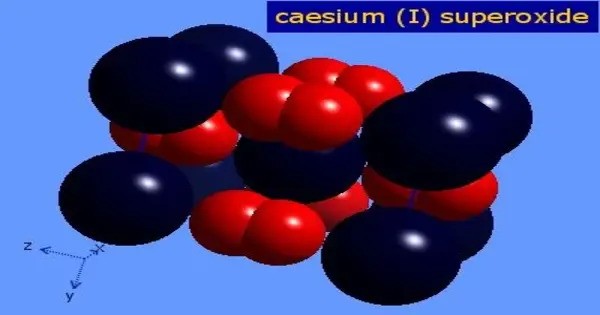
Caesium superoxide is a chemical compound with the chemical formula CsO2. It appears as a yellow to orange crystalline solid and is one of the most stable alkali metal superoxides due to the large ionic radius of caesium, which effectively stabilizes the superoxide ion. It consists of caesium cations Cs+ and superoxide anions O−2. It is an orange solid.
Caesium superoxide is formed by reacting caesium metal or caesium oxide with excess oxygen under controlled conditions. The compound is paramagnetic because of the unpaired electron in the superoxide ion. It is highly reactive, especially toward moisture and carbon dioxide, undergoing hydrolysis to produce caesium hydroxide and oxygen-containing species. Because of this strong reactivity, it must be handled and stored in dry, inert atmospheres.
Preparation
Burning caesium in excess oxygen will produce caesium superoxide.
Cs + O2 → CsO2
Caesium superoxide’s crystal structure is same as calcium carbide. It contains direct oxygen-oxygen bonding. It reacts with water to form hydrogen peroxide and caesium hydroxide.
2 CsO2 + 2 H2O → O2↑ + H2O2 + 2 CsOH
Heating to approximately 400 °C induces thermal decomposition to caesium peroxide. The standard enthalpy of formation ΔHf0 of caesium superoxide is −295 kJ/mol. Caesium superoxide reacts with ozone to form caesium ozonide.
CsO2 + O3 → CsO3 + O2
Properties
- Chemical formula: CsO2
- Molar mass: 164.903 g·mol−1
- Appearance: Yellow to orange solid
- Density: 3.77 g/cm3
- Melting point: 600 °C
- Solubility in water: reacts
Occurrences
Caesium superoxide is not found naturally due to its high reactivity and instability in the environment. It is a synthetically prepared compound, formed by the controlled oxidation of metallic caesium with excess oxygen. Because it reacts rapidly with moisture, carbon dioxide, and acids, it cannot persist under natural atmospheric or geological conditions and is therefore absent from mineral sources.
Applications
Caesium superoxide has limited practical applications, mainly confined to laboratory and research contexts. It is used in solid-state chemistry and materials research to study superoxide ions (O₂⁻) and their bonding behavior. Due to its ability to release oxygen upon reaction, it is sometimes examined in oxygen-generation studies, although potassium and sodium superoxides are preferred for industrial use. CsO₂ is also useful as a strong oxidizing agent in specialized chemical reactions and as a reference compound in spectroscopic and magnetic studies involving alkali metal superoxides.