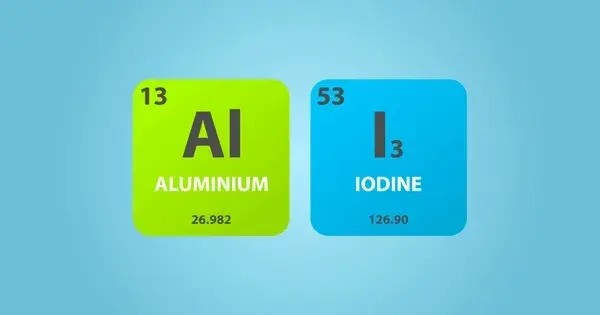
Aluminium iodide is a chemical compound containing aluminium and iodine. It typically appears as a white to pale yellow solid and is highly sensitive to moisture. In the presence of water, aluminium iodide reacts vigorously, decomposing to form aluminium hydroxide and hydrogen iodide, which makes it difficult to handle in air.
Aluminium iodide acts as a Lewis acid and is used in organic chemistry, especially as a catalyst in certain reactions such as alkylation. It is usually prepared by the direct reaction of aluminium metal with iodine. Because of its reactivity with moisture, aluminium iodide is stored under dry, inert conditions. It is employed as a reagent for the scission of certain kinds of C-O and N-O bonds. It cleaves aryl ethers and deoxygenates epoxides.
Properties
- Chemical formula: AlI3, AlI3·6H2O (hexahydrate)
- Molar mass: 407.695 g/mol (anhydrous), 515.786 g/mol (hexahydrate)
- Appearance: white (anhydrous) or yellow powder (hexahydrate)
- Density: 3.98 g/cm3 (anhydrous), 2.63 g/cm3 (hexahydrate)
- Melting point: 188.28 °C (370.90 °F; 461.43 K) (anhydrous), 185 °C, decomposes (hexahydrate)
- Boiling point: 382 °C (720 °F; 655 K) anhydrous, sublimes
- Solubility in water: very soluble, partial hydrolysis
- Solubility in alcohol, ethersoluble (hexahydrate)
Occurrences
- Aluminium iodide does not occur naturally in free form.
- It is synthetically prepared in laboratories by:
- Direct reaction of aluminium metal with iodine
- Reaction of aluminium compounds with hydrogen iodide under controlled conditions
- Due to its high reactivity with moisture, it is always handled in dry, inert environments.
Applications
- Chemical synthesis: Used as a reagent in organic chemistry, particularly for iodination reactions.
- Lewis acid catalyst: Acts as a Lewis acid in certain electrophilic substitution and rearrangement reactions.
- Research and laboratory use: Studied for understanding aluminium–halogen bonding and reaction mechanisms.
- Specialized reactions: Occasionally used in the preparation of organoiodine compounds.
Safety Note
Aluminium iodide must be handled with care, as it reacts violently with water and releases corrosive hydrogen iodide fumes. Proper protective equipment and dry conditions are essential.