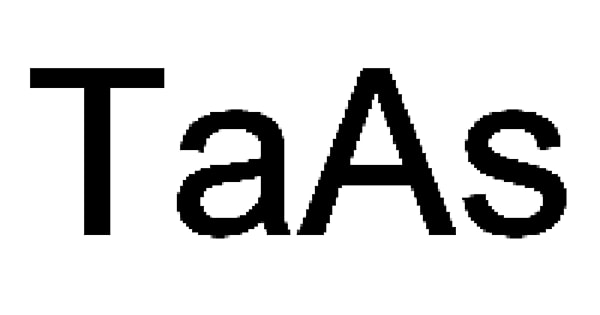
Tantalum Arsenide (TaAs) is an inorganic crystalline compound composed of tantalum (Ta) and arsenic (As). It is a compound of tantalum and arsenic with the formula TaAs. It is notable as being the first topological Weyl semimetal that was identified and characterized by ARPES. It exhibits an analogue of quantum vortices in momentum space. It has attracted major interest in condensed-matter physics because it is one of the first experimentally confirmed Weyl semimetals.
Tantalum arsenide has no widespread commercial use yet, but it is intensely studied for its fundamental physics and potential future applications in quantum computing, spintronics, and next-generation electronic devices. Its discovery helped open a new class of topological materials, deepening our understanding of how symmetry and topology govern electronic behavior in solids.
Properties
- Chemical formula: TaAs
- Molar mass: 255.869 g/mol
- Density: 12.25 g/cm3
- Melting point: Decomposes at 1400°C
Electronic Properties
- Weyl semimetal: One of the first experimentally confirmed Weyl semimetals (2015).
- Weyl nodes: Points in momentum space where conduction and valence bands touch.
- Fermi arcs: Unusual surface electronic states connecting Weyl nodes.
- High electron mobility
- Large magnetoresistance, even without magnetic ordering.
Electrical Behavior
- Metallic conductivity with strong anisotropy.
- Exhibits chiral anomaly effects when electric and magnetic fields are aligned.
Optical Properties
- Strong and broadband optical response.
- Nonlinear optical effects due to broken inversion symmetry.
- Efficient photocurrent generation under polarized light.
Chemically, TaAs is a hard, brittle solid with metallic conductivity. It is thermally stable and shows strong anisotropy in its electronic and transport properties due to its crystal structure.
Structure
Tantalum arsenide crystallizes in a body-centered tetragonal unit cell with lattice parameters a = 3.44 Å and c = 11.65 Å. It belongs to the space group I41md.
TaAs crystallizes in a non-centrosymmetric tetragonal structure, which is crucial for its electronic behavior. In this material, the conduction and valence bands intersect at discrete points called Weyl nodes, around which electrons behave like massless Weyl fermions.
Preparation
TaAs has been prepared by decomposing TaAs2 at 900 °C. A more recent preparation yielded large, single crystals of TaAs by chemical vapor transport with elemental precursors and iodine as the transport agent:
TaI5 (g) + AsI3 (g) ↔ TaAs (s) + 4 I2 (g)
Applications
- Fundamental physics research (topological states of matter)
- Quantum electronics
- Spintronics
- Ultrafast photonic devices
- Potential use in next-generation sensors and low-power electronics