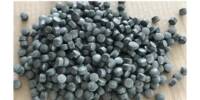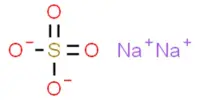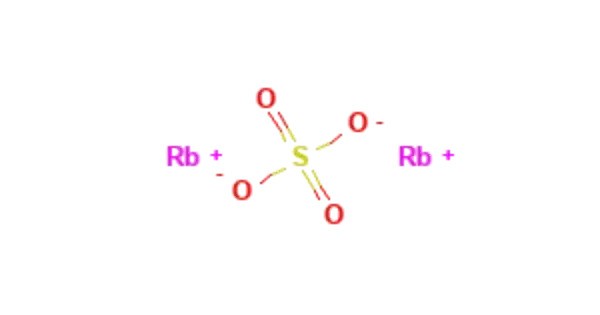
Rubidium sulfate is a sulfate of rubidium. The molecular formula of the compound is Rb2SO4. It appears as a white, crystalline solid and is highly soluble in water, forming colorless solutions. The molecular weight of this compound is 266.999 g/mol. An acid sulfate of rubidium (rubidium hydrogen sulfate) can be formed. It is soluble in water and is an aqueous solution. It has a relatively high melting point and shows typical ionic behavior due to the presence of rubidium cations and sulfate anions.
Rubidium sulfate occurs mainly as a laboratory-prepared compound rather than a naturally abundant mineral. It is commonly synthesized by neutralizing rubidium hydroxide or rubidium carbonate with sulfuric acid. In terms of applications, rubidium sulfate is used primarily in scientific research and analytical chemistry. It serves as a source of rubidium ions in spectroscopy, crystal growth studies, and specialized chemical experiments.
Properties
It appears as a white, crystalline solid and is highly soluble in water. Like other alkali metal sulfates, it is chemically stable and non-volatile. Rubidium sulfate has a relatively high melting point (around 1065 °C) and shows good thermal stability. In aqueous solution, it dissociates completely into rubidium (Rb⁺) and sulfate (SO₄²⁻) ions.
- Chemical formula: Rb2SO4
- Density: 3.613
- Melting point: 1,050 °C (1,920 °F; 1,320 K)
- Boiling point: 1,700 °C (3,090 °F; 1,970 K)
- Solubility in water: 50.8 (g/L)
Reactions
Y2(SO4)3 + Rb2SO4 → Rb3[Y(SO4)3]
Rb2SO4 + H2SO4 → 2 RbHSO4
Occurrences
Rubidium sulfate does not occur freely in nature. Rubidium itself is a rare alkali metal and is usually obtained as a by-product during the processing of minerals such as lepidolite, pollucite, and carnallite. Rubidium sulfate is produced industrially by reacting rubidium hydroxide or rubidium carbonate with sulfuric acid.
Applications
Rubidium sulfate is mainly used in scientific research and analytical chemistry. It serves as a source of rubidium ions in laboratory experiments and spectroscopy studies. It is also used in specialty glass and ceramics, where rubidium compounds help modify electrical and optical properties. Additionally, rubidium sulfate is employed in biochemical and medical research for controlled ionic studies, though its commercial use is limited due to the rarity and cost of rubidium.