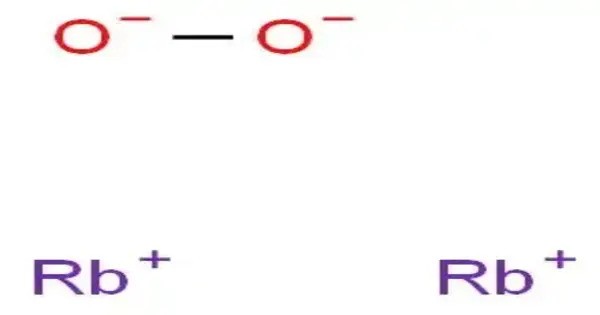
Rubidium peroxide is rubidium’s peroxide with the chemical formula Rb2O2. It is one of several oxygen-rich oxides of rubidium, and it belongs to the class of alkali-metal peroxides. It is a bright yellow, highly reactive solid that contains the peroxide anion, is prepared by controlled oxidation of the metal, and serves primarily as a strong laboratory oxidant and as a subject of academic study rather than industrial use.
Production
Rubidium peroxide can be produced by rapidly oxidizing rubidium in liquid ammonia at −50°C.
2 Rb+O2 → -50 → Rb2O2
It can also be produced by pyrolysis of rubidium superoxide in vacuum.
2RbO2 → 290C → Rb2O2 + O2
Properties
Rubidium peroxide is a colourless to light yellow solid with the orthorhombic crystal structure.
- Chemical formula: O2Rb2
- Molar mass: 202.934 g·mol−1
- Appearance: colourless solid
- Density: 3.80 g·cm−3
- Melting point: 570 °C
- Solubility in water: reacts
Preparation
Controlled oxidation of rubidium metal (most common lab method)
2 Rb + O₂ → Rb₂O₂
The reaction is carried out in anhydrous conditions with a limited supply of dry oxygen or air at 100–300 °C. Excess oxygen or higher temperature leads to the superoxide RbO₂ instead.
Reaction of rubidium hydroxide with hydrogen peroxide (less common)
2 RbOH + H₂O₂ → Rb₂O₂ + 2 H₂O
Requires careful removal of water and excess H₂O₂.
Chemical Reactivity
Highly reactive alkali-metal peroxide, more reactive than sodium peroxide (Na₂O₂) but less than potassium, cesium, or francium peroxides.
Reacts violently with water: Rb₂O₂ + 2 H₂O → 2 RbOH + H₂O₂
The liberated hydrogen peroxide then decomposes to water and oxygen, often with enough heat to ignite combustible materials.
Strong oxidizing agent: oxidizes CO to CO₂, SO₂ to sulfate, and many organic compounds.
Reacts with CO₂ (even atmospheric CO₂) to form rubidium carbonate and oxygen:
2 Rb₂O₂ + 2 CO₂ → 2 Rb₂CO₃ + O₂
Thermally decomposes above ≈600 °C: 2 Rb₂O₂ → 2 Rb₂O + O₂
Uses and Applications
- Rarely used commercially because rubidium is expensive and the compound is extremely reactive.
- Occasionally employed in specialized laboratory oxidations.
- Historically investigated (along with other alkali-metal peroxides) for air-revitalization systems in submarines and spacecraft because it both absorbs CO₂ and releases O₂.
- Research reagent in inorganic and solid-state chemistry, especially for studying peroxide chemistry of heavy alkali metals.
Safety and Handling
- Powerful oxidizer → risk of fire or explosion when in contact with organic materials or reducing agents.
- Reacts explosively with water or acids.
- Must be handled under inert atmosphere (dry argon or nitrogen) in a glove box.
- Contact with skin or eyes causes severe alkali burns; peroxide decomposition can liberate oxygen and heat.