Potassium phthalimide is a chemical compound of formula C8H4KNO2. It is the potassium salt of phthalimide, and usually presents as fluffy, very pale yellow crystals. The compound appears as a white to off-white crystalline solid and is odorless. It can be prepared by adding a hot solution of phthalimide in ethanol to a solution of potassium hydroxide in ethanol; the desired product precipitates. It is sparingly soluble in water but dissolves better in polar solvents such as ethanol and dimethylformamide (DMF).
The compound is stable under normal conditions, but it should be stored in a cool, dry place away from moisture and acids. It decomposes at high temperatures, producing nitrogen oxides and carbon oxides.
Structure
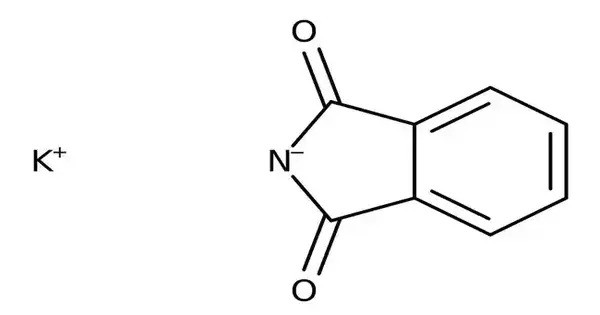
Potassium phthalimide’s structure contains an aromatic imide ring and a potassium cation, contributing to its nucleophilic nature in substitution reactions. It plays a crucial role in pharmaceutical synthesis, polymer chemistry, and other fields of organic and medicinal chemistry.
Properties
It appears as a white to slightly yellow crystalline powder. The compound is stable, non-hygroscopic, and soluble in water and polar organic solvents such as dimethylformamide (DMF). It has a high melting point, typically around 350–360°C, and is known for being a strong nucleophile in organic synthesis. Chemically, it is derived from phthalimide (C₆H₄(CO)₂NH) by replacing the acidic hydrogen atom with potassium.
- Chemical formula: C8H4KNO2
- Molar mass: 185.221 g/mol
- Appearance: Light yellow solid
- Melting point: > 300 °C (572 °F; 573 K)
- Solubility in water: Soluble in water
Potassium phthalimide is a key reagent in organic synthesis, most notably used in the Gabriel synthesis for preparing primary amines. In this reaction, it reacts with alkyl halides to form N-alkylphthalimides, which are subsequently hydrolyzed or treated with hydrazine to release the desired amine. This process is highly valued for yielding pure amines without secondary or tertiary amine byproducts.
Occurrences
Potassium phthalimide does not occur naturally; it is synthesized in laboratories by reacting phthalimide with potassium hydroxide (KOH) in an aqueous or alcoholic medium. It is widely used in organic chemistry, particularly in the Gabriel synthesis for preparing primary amines from alkyl halides. Because of its stability and reactivity, it is a valuable reagent in both academic and industrial chemical research.