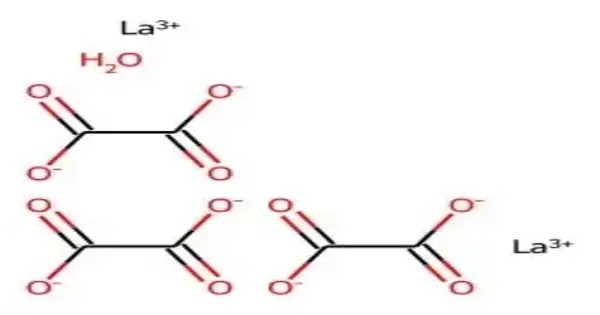
Lanthanum oxalate is an inorganic compound, a salt of lanthanum metal and oxalic acid with the chemical formula La2(C2O4)3. The compound typically appears as a white to pale crystalline or powdery solid and is insoluble in water but soluble in strong acids. It plays a significant role in rare-earth chemistry, especially in material preparation and industrial refinement processes.
Lanthanum oxalate is mainly produced by precipitating lanthanum salts, such as lanthanum chloride or nitrate, with oxalic acid or soluble oxalates. Upon heating, it decomposes to form lanthanum oxide (La₂O₃), making it an important intermediate in rare-earth processing.
Synthesis
Reaction of soluble lanthanum nitrate with an excess of oxalic acid:
2 La(NO3)3 + 3 (COOH)2 → La2(C2O4)3 + 6 HNO3
Also, a reaction of lanthanum chloride with oxalic acid:
2 LaCl3 + 3 H2C2O4 → La2(C2O4)3 + 6 HCl
Physical properties
Lanthanum(III) oxalate forms colorless crystals that are poorly soluble in water.The compound forms various crystallohydrates La2(C2O4)3•nH2O, where n = 1, 2, 3, 7, and 10. The crystallohydrates decompose when heated.
- Chemical formula: C6La2O12
- Molar mass: 541.87 g/mol
- Appearance: colorless crystals
- Density: g/cm3
- Solubility in water: poorly soluble
Lanthanum oxalate appears as a white to off-white crystalline powder. It is insoluble in water but slightly soluble in strong acids. On heating, it decomposes to form lanthanum oxide (La₂O₃), releasing carbon monoxide and carbon dioxide. The compound is thermally stable at moderate temperatures and exhibits typical chemical behavior of rare-earth oxalates.
Occurrence
Lanthanum oxalate does not occur naturally as a mineral. It is produced synthetically in laboratories and industrial processes, usually as an intermediate compound during the purification and separation of lanthanum from rare-earth ores such as monazite and bastnäsite.
Applications
Lanthanum oxalate is mainly used as a precursor for lanthanum oxide, which is important in optical glass, ceramics, catalysts, and electronic materials. In analytical and separation chemistry, it is used for precipitating lanthanum ions from solutions. It also plays a role in rare-earth research and material synthesis processes.
In terms of applications, lanthanum oxalate is widely used in the separation and purification of lanthanum and other rare-earth elements during hydrometallurgical processes. It also serves as a precursor for producing high-purity lanthanum oxide used in optical glass, catalysts, ceramics, and electronic materials. Additionally, lanthanum oxalate has relevance in medical research, as lanthanum compounds are studied for their phosphate-binding properties.