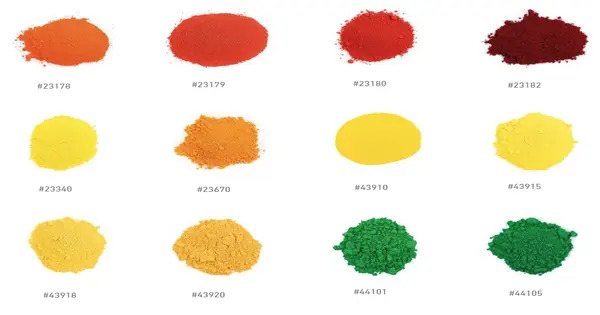
Cadmium pigments are a group of inorganic colorants primarily based on cadmium sulfide (CdS) and cadmium sulfoselenide (CdS·CdSe). They are a class of pigments that contain cadmium. They produce bright, stable colors ranging from lemon yellow and deep yellow to orange and red. These pigments are valued for their excellent lightfastness, high tinting strength, heat resistance, and chemical stability, making them suitable for high-performance applications.
Most of the cadmium produced worldwide has been for use in rechargeable nickel–cadmium batteries, which have been replaced by other rechargeable nickel-chemistry cell varieties such as NiMH cells, but about half of the remaining consumption of cadmium, which is approximately 2,000 tonnes (2,200 short tons) annually, is used to produce colored cadmium pigments. The principal pigments are a family of yellow, orange and red cadmium sulfides and sulfoselenides, as well as compounds with other metals.
Cadmium is toxic in very small amounts to humans and other animals, especially when it is inhaled, which often happens when working with powdered pigment or breathing the dust from chalk pastels. As a result, it is not appropriate for children to use any art supplies that contain cadmium pigments. However, because the pigments have some desirable qualities, such as resistance to fading, some adult artists continue to use them.
Properties
Cadmium pigments are inorganic pigments mainly based on cadmium sulfide (CdS), cadmium selenide (CdSe), or their solid solutions. They exhibit bright, intense colors ranging from lemon yellow and orange to deep red. These pigments are known for excellent lightfastness, high tinting strength, and outstanding thermal stability, often withstanding temperatures above 300 °C. They are insoluble in water and most solvents, chemically stable, and resistant to weathering, alkalis, and many acids. However, cadmium pigments are toxic due to the presence of cadmium, which has led to strict regulations on their use.
Occurrences
Cadmium pigments do not occur naturally as pigments. Cadmium itself is obtained mainly as a by-product of zinc ore processing, particularly from sphalerite (ZnS). Industrially, cadmium compounds are synthesized and processed under controlled conditions to produce pigments with specific particle sizes and hues. These pigments are manufactured rather than mined in pigment form.
Applications
Cadmium pigments have been widely used in plastics, ceramics, glass, enamels, coatings, and artists’ paints, especially where vivid color and durability are required. They maintain color integrity at high processing temperatures and under prolonged exposure to sunlight.
However, cadmium pigments contain cadmium, a toxic heavy metal, raising serious health and environmental concerns. Due to strict regulations in many countries, their use has been significantly restricted or replaced by safer alternatives such as organic and mixed-metal pigments. Today, cadmium pigments are mainly used in specialized industrial or artistic applications under controlled conditions.