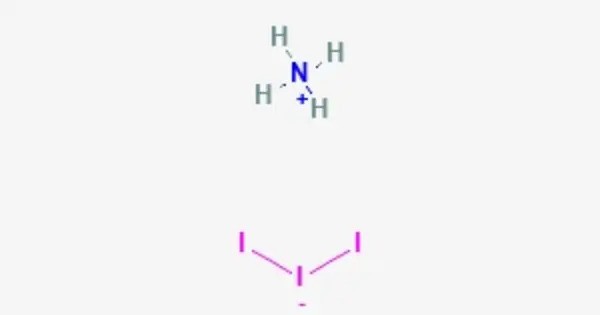
Ammonium triiodide (NH4I3) is the salt of the ammonium cation with the triiodide anion. It is a highly unstable and explosive inorganic compound composed of ammonium (NH₄⁺) and triiodide (I₃⁻) ions. It is typically produced by reacting concentrated ammonia with iodine crystals, forming a dark brown or nearly black solid. The compound is extremely sensitive to physical contact, vibration, heat, and even exposure to light, often detonating with a sharp snap upon slight disturbance.
Chemically, ammonium triiodide is not a true stoichiometric compound but a mixture of iodine and nitrogen triiodide–ammonia complex (NI₃·NH₃). It decomposes violently, producing nitrogen gas and iodine vapor, a reaction that is used in demonstrations to illustrate chemical instability and rapid gas evolution.
Properties
It is a highly unstable and sensitive chemical compound composed of ammonium and triiodide ions. It appears as a dark brown to nearly black crystalline solid. It is extremely sensitive to touch, friction, and even slight vibrations, often detonating spontaneously. Chemically, it releases iodine vapors upon decomposition and has a pungent odor. It is insoluble in most organic solvents but can decompose rapidly in moist air or under light.
- Chemical formula: H4I3N
- Molar mass: 398.752 g·mol−1
Sometimes the name ammonium triiodide is mistakenly used to refer to a different compound, nitrogen triiodide (NI3), or more precisely, the slightly more stable ammine, NI3 · NH3.
Occurrences
Ammonium triiodide is not naturally occurring; it is a synthetic compound prepared in laboratories by reacting iodine with concentrated ammonia solution. During preparation, a black solid precipitate forms, which is the highly unstable ammonium triiodide complex (often a mixture of nitrogen triiodide-ammonia adducts).
Applications
Due to its extreme instability and explosiveness, ammonium triiodide has no practical industrial applications. It is mainly used in educational and demonstration experiments to illustrate chemical sensitivity and explosive decomposition reactions. Researchers also study it to understand nitrogen-halogen bond chemistry and instability mechanisms in halogenated nitrogen compounds.
Because of its extreme instability, ammonium triiodide has no practical commercial applications and is handled only in controlled laboratory environments for educational or experimental purposes. It serves as a classic example of an impact-sensitive explosive and the delicate balance of molecular forces in unstable compounds. Proper safety precautions—such as preparing minute quantities, keeping the compound moist, and avoiding friction—are essential to prevent accidental detonation.