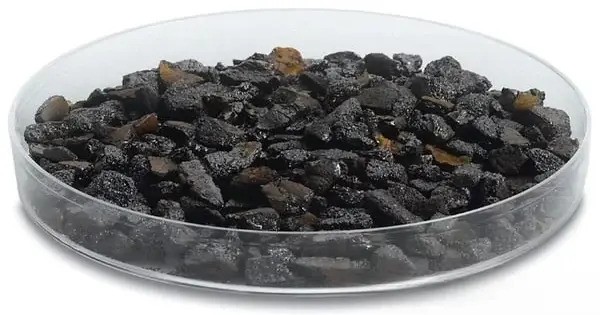
Tantalum telluride (TaTe2) is a chemical compound of tantalum and tellurium. It is a layered transition metal dichalcogenide (TMDC), typically crystallizing in a monoclinic structure, and belongs to a broader class of materials with the general formula MX₂, where M is a transition metal and X is a chalcogen. Tantalum also forms a tantalum rich telluride with the approximate formula Ta1.6Te that is unusual in that it forms dodecagonal chalcogenide quasicrysstals, a formation that cannot occur in a normal crystal because it does not result in a periodic crystal lattice.
TaTe₂ exhibits intriguing electronic and structural properties, including charge density wave (CDW) behavior, which involves periodic modulations of electron density and lattice distortion. These properties make it of interest for fundamental research in condensed matter physics and potential applications in nanoelectronics and quantum materials.
TaTe₂ is generally synthesized via chemical vapor transport or solid-state reaction methods. It is sensitive to air and moisture, requiring careful handling under inert conditions. Research continues into its band structure, phase transitions, and possible use in next-generation electronic devices.
Properties
- Chemical formula: TaTe2
- Molar mass: 436.145 g/mol
- Density: 9.4 g/cm3
Occurrence
Tantalum telluride is not naturally occurring in large quantities as a mineral and is synthesized in laboratories or via solid-state reactions. It is mainly produced for research purposes or in small quantities for advanced electronic applications.
Applications
Though not widely used in industry yet, TaTe₂ and related compounds have promising applications in cutting-edge fields:
(1) 2D Materials and Nanoelectronics
- Part of the growing class of 2D TMDs.
- Potential in field-effect transistors (FETs), sensors, and nanoelectronics.
(2) Quantum Materials Research
- Studied for charge density wave dynamics and topological phase transitions.
- Candidate for hosting Weyl fermions or topologically protected states under certain conditions.
(3) Energy Applications
- Interest in thermoelectric properties, though not as extensively studied as other tellurides like Bi₂Te₃.