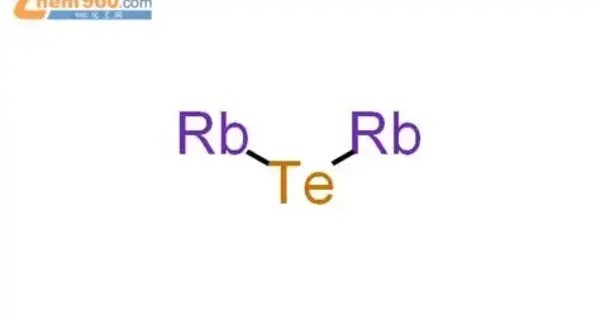
Rubidium telluride is the inorganic compound with the formula Rb2Te. It is an inorganic compound composed of rubidium and tellurium. It is a yellow-green powder that melts at either 775 °C or 880 °C (two different values have been reported). It is an obscure material of minor academic interest. It belongs to the family of alkali metal tellurides and is typically formed by direct combination of rubidium and tellurium at elevated temperatures.
The compound appears as a dark crystalline solid and is highly reactive, particularly with moisture and oxygen, forming tellurium oxides and rubidium hydroxide upon exposure to air or water. Like other alkali metal chalcogenides, Rb2Te is prepared from the elements in liquid ammonia.
Properties
In terms of physical properties, rubidium telluride has a high melting point and good electrical conductivity that varies with temperature, indicating potential use in high-temperature electronic devices. However, due to rubidium’s reactivity and the toxicity of tellurium compounds, Rb₂Te must be handled in controlled environments under inert gas. Though not widely used commercially, rubidium telluride remains of scientific importance for research into alkali metal–chalcogen bonding and solid-state materials.
- Chemical formula: Rb2Te
- Molar mass: 298.54 g/mol
- Appearance: yellow-green powder
- Melting point: 775 °C (1,427 °F; 1,048 K)
Rubidium telluride crystallizes in an antifluorite structure, where tellurium atoms form a face-centered cubic lattice and rubidium ions occupy the tetrahedral sites. It exhibits strong ionic character, typical of alkali metal chalcogenides. The compound is known for its semiconducting properties, which make it of interest in thermoelectric materials and optoelectronic applications.
Occurrences
Rubidium telluride is not naturally found in the Earth’s crust, as rubidium and tellurium rarely occur together in significant amounts. Instead, it is synthesized in laboratories or through controlled metallurgical processes. Rubidium is mainly obtained from minerals such as lepidolite and pollucite, while tellurium is extracted from copper refining residues. Rb₂Te is primarily a man-made compound for research and specialized applications rather than a naturally occurring mineral.
Application
Rubidium telluride is used in some space-based UV detectors. It remains primarily a subject of academic and experimental study rather than widespread industrial use.
- Semiconductors: Rubidium telluride exhibits semiconducting properties, making it of interest for optoelectronic and thermoelectric materials research.
- Infrared Detectors: Due to its specific bandgap and photoresponse, it may be studied for infrared detection systems.
- Scientific Research: Used in solid-state chemistry to explore alkali metal–chalcogen bonding and structural properties.
- Thin-Film Materials: Potential use in developing layered or mixed chalcogenide films for electronic devices.