Rubidium superoxide or rubidium hyperoxide is a chemical compound with the chemical formula RbO2. It is an inorganic compound composed of rubidium and oxygen. In terms of oxidation states, the negatively charged superoxide and positively charged rubidium give it a structural formula of Rb+[O2]−. It belongs to the family of alkali metal superoxides, characterized by the presence of the superoxide anion (O₂⁻). This compound is typically formed when rubidium metal reacts directly with oxygen gas under controlled conditions.
Rubidium superoxide is an orange-yellow crystalline solid, highly reactive and sensitive to moisture and carbon dioxide. It has a molecular weight of about 118.47 g/mol and crystallizes in a tetragonal structure. The superoxide ion in RbO₂ contains one unpaired electron, giving the compound paramagnetic properties. Rubidium superoxide is a strong oxidizing agent, capable of reacting violently with water to produce rubidium hydroxide (RbOH) and oxygen gas.
Properties
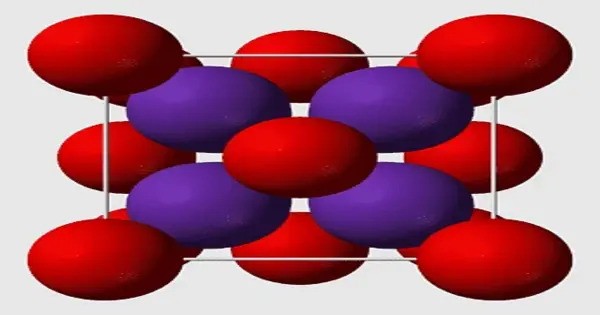
Roughly speaking, RbO2 has a crystal structure similar to tetragonal calcium carbide, but is rather distorted due to the Jahn–Teller effect, which makes the crystal structure less symmetrical. RbO2 is stable in dry air, but is extremely hygroscopic. The compound has been studied as an example of magnetism arising intrinsically from the p-shell. RbO2 has been predicted to be a paramagnetic Mott insulator. At low temperatures, it transitions to antiferromagnetic order, with a Neel temperature of 15 K.
- Chemical formula: RbO2
- Molar mass: 117.466 g·mol−1
- Appearance: Bright yellow
Chemistry
It can be created by slowly exposing elemental rubidium to oxygen gas:
Rb(s) + O2(g) → RbO2(s)
Like other alkali metal hyperoxides, crystals can also be grown in liquid ammonia.
Between 280 and 360 °C, Rubidium superoxide will decompose, leaving not rubidium sesquioxide (Rb2O3), but rather rubidium peroxide (Rb2O2).
2 RbO2(s) → Rb2O2(s) + O2(g)
An even more oxygen rich compound, that of rubidium ozonide (RbO3) can be created using RbO2 and ozone.
Occurrences
Rubidium superoxide does not occur naturally. It is synthesized in laboratories by directly reacting rubidium metal with oxygen at controlled temperatures (usually below 300°C) to prevent the formation of other oxides like Rb₂O₂ or Rb₂O.
It has limited but specialized applications. It is used in research on alkali metal oxides and superoxides, oxygen storage and generation systems, and chemical oxygen demand studies. In addition, it serves as a strong oxidizing agent in experimental chemistry and is studied for its magnetic and electronic properties, which are of interest in solid-state and materials science.
Applications
In practical applications, rubidium superoxide is used mainly in laboratory research, particularly in studying solid-state chemistry, oxygen storage materials, and alkali metal–oxygen interactions. Its chemical behavior is similar to that of potassium and cesium superoxides but with distinct stability characteristics. Due to its reactivity and corrosive nature, it must be handled carefully in inert or dry atmospheres. Rubidium superoxide remains an important material for understanding alkali metal oxidation states and superoxide chemistry.