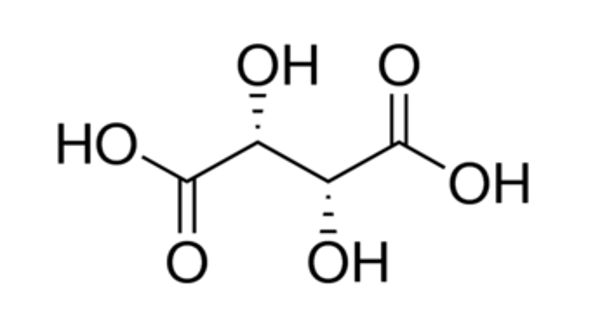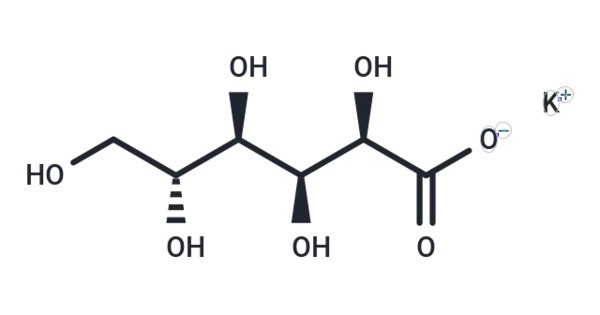
Potassium gluconate is the potassium salt of the conjugate base of gluconic acid. It is also referred to as 2,3,4,5,6-pentahydroxycaproic acid potassium salt, D-gluconic acid potassium salt, or potassium D-gluconate. It contains 16.69% elemental potassium by mass. Thus 5.99 g of potassium gluconate contains 1 g of potassium. It has a density of 1.73 g/cm3.
Properties
It is an odorless, white-to-yellowish crystalline powder, highly soluble in water. It’s the potassium salt of gluconic acid, used primarily as a mineral supplement to treat or prevent hypokalemia (low blood potassium). Each gram provides ~16.7% elemental potassium (166 mg).
- Formula: C₆H₁₁KO₇ (anhydrous); often encountered as the monohydrate C₆H₁₁KO₇·H₂O.
- Molecular Weight: 234.25 g/mol (anhydrous); 252.26 g/mol (monohydrate).
- Appearance: White to yellowish-white, crystalline powder or granules; odorless or nearly odorless, with a slightly bitter/saline taste.
- Solubility: Highly soluble in water (~1 g in 1 mL at 25 °C; forms clear, colorless solutions). Practically insoluble in ethanol, ether, benzene, and chloroform.
- Melting Point: Decomposes above ~180 °C without melting (loses water of hydration ~100 °C for monohydrate).
- Density: ~1.73 g/cm³ (anhydrous).
- pH: 5% aqueous solution is 7.0–8.3 (neutral to slightly alkaline).
- Hygroscopicity: Moderately hygroscopic; absorbs moisture from air.
Dietary uses
Potassium gluconate is used as a mineral supplement and sequestrant. It is sold over-the-counter as tablets or capsules providing up to 593 mg of potassium gluconate, thereby containing 99 mg or 2.53 milliequivalents of elemental potassium. This is the permissible upper limit for each tablet or capsule of over-the-counter potassium supplements sold in the US. Potassium gluconate is also sold over-the-counter as bulk powder.
As a food additive, potassium gluconate is used as an acidity regulator and yeast food. It is known as E number reference E577.
Natural Occurrences
Biosynthesis: Gluconic acid produced by microbial oxidation of glucose (e.g., Aspergillus niger, Gluconobacter spp.) during fermentation of corn syrup or molasses. Potassium salt formed by neutralizing with KOH or K₂CO₃.
Natural Sources: Trace amounts in honey, fruits, and wine due to bacterial action, but commercial material is always synthetic/fermentation-derived.
Indications
Potassium deficiency from diuretics, corticosteroids, or poor diet. Dosage: 40–100 mEq/day (adults), adjusted via serum levels.
Side effects
Hyperkalemia (rare with normal renal function), nausea, diarrhea. Contraindicated in renal failure, Addison’s disease, or with K⁺-sparing diuretics. Monitor serum K⁺, especially in elderly or CKD patients. FDA-approved, GRAS for food use as a sequestrant/nutrient. (128 words)
Safety
Its oral median lethal dose (LD50) in rats is 10.38 g/kg. This is not an indicator of a safe oral daily dose in rats or humans.