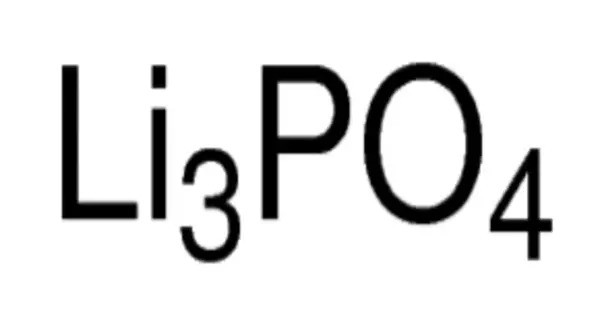
Lithium phosphate is a phosphate salt of lithium, with the molecular formula Li3PO4.[3] It is a white solid slightly soluble in water. It is an inorganic compound composed of lithium, phosphorus, and oxygen. It appears as a white, crystalline solid that is insoluble in water but soluble in acids. Lithium phosphate crystallizes in the orthorhombic system and has a relatively high melting point of about 837°C. It is chemically stable and non-hygroscopic, making it suitable for various industrial and scientific applications.
It is primarily used in the production of lithium iron phosphate (LiFePO4) for making lithium-ion batteries. One of its major uses is in lithium-ion batteries, where it serves as a solid electrolyte or cathode material, particularly in the form of lithium iron phosphate (LiFePO₄). It also finds applications in ceramics, glass production, and optical materials, where it helps improve thermal and chemical stability.
Properties
It appears as a white, crystalline solid that is insoluble in water but soluble in acids. It has a high melting point of around 837°C and exhibits good thermal and chemical stability. It crystallizes in an orthorhombic structure and is known for its ionic conductivity, making it useful in solid-state batteries and ceramics. It is chemically stable under normal conditions and non-hygroscopic.
- Chemical formula: Li3PO4
- Molar mass: 115.794 g/mol
- Appearance: White powder
- Density: 2.46 g/cm3
- Melting point: 1,205 °C (2,201 °F; 1,478 K)
- Solubility in water: 0.027 g/100 mL (25 °C)
Synthesis and structure
Trilithium phosphate can be produced by the neutralization of lithium carbonate using phosphoric acid:
3 Li2CO3 + 2 H3PO4 → 2 Li3PO4 + 3 H2O + 3 CO2
The low-temperature polymorph (β-Li3PO4) crystallizes as an orthorhombic crystal with the space group Pmn21. If heated to above 500 °C, it converts to another polymorph, γ-Li3PO4.
Occurrences
Lithium phosphate is not commonly found in nature as a pure mineral. However, it can occur in small amounts in lithium-bearing pegmatites and can be synthesized industrially by reacting lithium carbonate or lithium hydroxide with phosphoric acid. It is mainly produced for use in lithium iron phosphate (LiFePO₄) batteries, ceramics, glass coatings, and catalysis applications.
Application
In analytical chemistry, lithium phosphate is used as a standard reagent and in phosphate buffer solutions. It can be synthesized by reacting lithium carbonate or lithium hydroxide with phosphoric acid. Environmentally, it is considered relatively safe, though lithium compounds should be handled with care due to potential toxicity in large amounts.
Health Hazards
Large doses of lithium phosphate may cause dizziness, and sometimes, kidney damage. According to some reports, dehydration, weight loss, and thyroid disturbances can occur due to high exposure of lithium ions. Nervous system defects, including slurred speech, blurred vision, sensory loss, and convulsions may also occur.