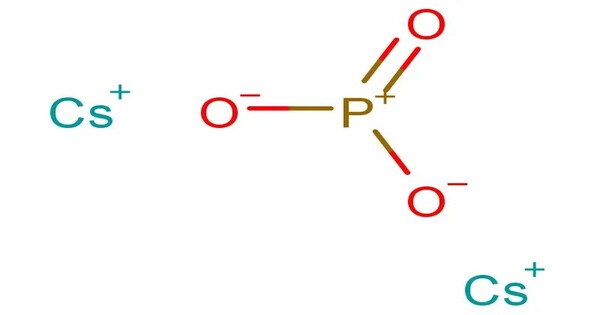
Caesium phosphate, Cs3PO4, is a phosphate of caesium that is highly soluble in water. It is an inorganic chemical compound composed of caesium (Cs) and phosphate (PO₄³⁻) ions, commonly represented by the formula Cs₃PO₄. It appears as a white, crystalline solid and is highly soluble in water, forming strongly alkaline solutions due to the basic nature of the phosphate ion and the electropositive character of caesium.
One of the key properties of caesium phosphate is its high basicity, which makes it particularly useful as a base in organic synthesis. In laboratory and industrial chemistry, it is often employed as a catalyst or reagent in carbon–carbon and carbon–heteroatom coupling reactions, especially in palladium-catalyzed processes such as Suzuki and Heck reactions. Its strong basic strength, combined with good solubility in polar solvents, enhances reaction efficiency.
Properties
Caesium phosphate is an inorganic compound appearing as a white, hygroscopic crystalline solid. It is highly soluble in water and exhibits strong basic (alkaline) behavior due to the presence of the phosphate ion. The compound has a relatively high melting point and shows good thermal stability under normal conditions. Because caesium is a heavy alkali metal, caesium phosphate has a high ionic character and excellent ionic conductivity in certain environments.
- Chemical formula: Cs3PO4
- Molar mass: 493.69 g/mol
Occurrence
Caesium phosphate does not occur naturally in free form. It is synthesized industrially, typically by reacting caesium hydroxide or caesium carbonate with phosphoric acid, followed by controlled crystallization. Caesium itself is obtained from minerals such as pollucite, after which it is processed into various caesium salts, including caesium phosphate.
Applications
Caesium phosphate is widely used as a strong, non-nucleophilic base in organic synthesis, particularly in carbon–carbon and carbon–heteroatom coupling reactions. It is valued in pharmaceutical and fine chemical industries for its high reactivity and selectivity.
Caesium phosphate also finds applications in materials science and electronics, where it is studied for its ionic conductivity and potential use in solid electrolytes. Additionally, it has relevance in photovoltaic and optoelectronic research, particularly in surface modification and interface engineering.
Safety
Despite its usefulness, caesium phosphate must be handled with care, as its alkaline nature can cause irritation to skin and eyes. Proper storage in airtight containers is recommended to prevent moisture absorption and degradation.