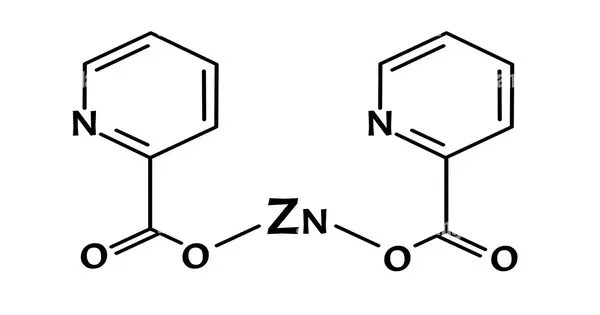
Zinc picolinate (or ZnPic) is the zinc coordination complex derived from picolinic acid and zinc(II). It has the formula Zn(NC5H4CO2)2(H2O)2. It is a white crystalline powder that is sparingly soluble in water and serves as a zinc supplement for human nutrition. The complex adopts an octahedral molecular geometry, containing two bidentate picolinate ligands (conjugate base of picolinic acid) and two aquo ligands. The picolinate form enhances zinc’s bioavailability, allowing better absorption in the small intestine compared to other zinc salts such as zinc gluconate or zinc sulfate.
In the body, zinc is an essential trace element involved in enzyme activity, immune function, wound healing, DNA synthesis, and cell division. Zinc picolinate is often used to prevent or treat zinc deficiency, which can cause symptoms such as hair loss, delayed wound healing, impaired immunity, and skin disorders.
Related compounds
Other zinc(II) complexes of picolinic acid have been described. Isostructural with the zinc complex are M(NC5H4CO2)2(H2O)2·2H2O (M = Co and Ni).
Properties
It appears as a white crystalline powder that is soluble in water and slightly soluble in alcohol. It consists of zinc bound to picolinic acid, a natural metabolite of tryptophan. This compound is a highly bioavailable form of zinc, meaning it is efficiently absorbed by the human body. It is stable under normal conditions and non-hygroscopic. The molecular weight is approximately 305.6 g/mol.
Occurrences
Zinc picolinate does not occur naturally in significant amounts. It is a synthetic compound, produced by combining zinc salts (such as zinc oxide or zinc acetate) with picolinic acid. Picolinic acid itself is found in trace amounts in biological systems as part of amino acid metabolism.
Dietary supplement
Zinc picolinate has been used as a dietary zinc supplement. This compound is stable under normal conditions and usually taken orally in capsule or tablet form. It has been studied for its potential roles in supporting reproductive health, cognitive function, and skin health. However, excessive intake can lead to nausea, vomiting, and copper deficiency due to interference with mineral balance.