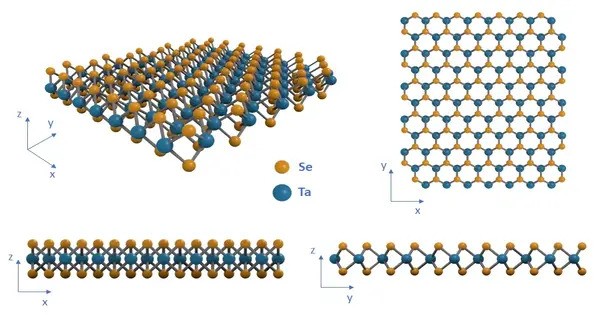
Tantalum diselenide is a compound made with tantalum and selenium atoms, with chemical formula TaSe2, which belongs to the family of transition metal dichalcogenides. It is a layered transition metal dichalcogenide (TMD) material, composed of tantalum (Ta) and selenium (Se) atoms in a 1:2 ratio. In contrast to molybdenum disulfide (MoS2) or rhenium disulfide (ReS2), tantalum diselenide does not occur spontaneously in nature, but it can be synthesized. It belongs to the family of two-dimensional (2D) materials, similar to graphene or molybdenum disulfide, and exhibits fascinating quantum phenomena due to its electronic structure.
TaSe₂ is metallic in its bulk form and is particularly notable for hosting charge density waves (CDWs) and superconductivity, making it a model system for studying the interplay between these states. Its properties are highly tunable through thickness, doping, intercalation, or structural phase changes, which has sparked interest in fundamental physics and potential applications in electronics and nanotechnology.
Properties
- Chemical formula: Se2Ta
- Molar mass: 338.890 g·mol−1
- Appearance: Silverish/goldish solid
- Density: ~6.7 g/cm³.
- Melting Point: >1,300°C (highly heat-resistant).
- Color: Metallic sheen; turns darker with air exposure due to oxidation.
- Friction: Not great as a lubricant (coefficient ~0.15–0.3, increases with use).
Electrical Properties
- Metallic conductivity in bulk (resistivity ~10⁻⁴ Ω·cm).
- In thin layers: Non-linear current-voltage behavior; tunable via gating.
- Hall effect: Negative coefficient below 120 K, indicating electron-dominated transport.
Optical Properties
- Strong absorption/emission across visible to near-IR (peak at ~532 nm).
- Non-linear refractive index: High values (e.g., n₂ = 8 × 10⁻⁷ cm²/W at 532 nm), useful for optical switching.
- Photoluminescence: Weak in bulk but enhanced in heterostructures (e.g., with MoS₂).
Thermal Properties
- High thermal stability.
- Phase transitions tied to CDWs (see below).
Crystal Structure and Polytypes
TaSe₂ adopts a layered hexagonal structure where tantalum atoms are sandwiched between two layers of selenium atoms, forming TaSe₂ sheets held together by weak van der Waals forces. This allows for easy exfoliation into few-layer or monolayer forms. The material exists in several polytypes, which differ in layer stacking and stability:
- 2H-TaSe₂: The most common phase, stable at room temperature. It features a hexagonal stacking with two layers per unit cell. This phase shows metallic behavior and undergoes CDW transitions.
- 1T-TaSe₂: Stable at higher temperatures (around 800°C), with a trigonal prismatic coordination. In monolayers, it becomes insulating and exhibits strong CDW order with periodic lattice distortions.
- 3R-TaSe₂: A rhombohedral phase with three layers per unit cell, showing enhanced superconductivity.
- 4Ha-TaSe₂: A less common phase with self-intercalated tantalum atoms, exhibiting superconductivity at higher temperatures than the 2H phase.
- 4Hb-TaSe₂: Observed in some intercalated forms, such as with platinum doping.
Occurrences
Natural: None! TaSe₂ doesn’t form in nature. Tantalum occurs in minerals like tantalite (Fe,Mn)Ta₂O₆ or columbite, but selenium binding to form TaSe₂ requires lab synthesis.
Synthesis/Production:
- CVT: Ta + Se in sealed tube with iodine, heated to 800–1,000°C.
- CVD: On substrates like gold at ~650°C.
- Exfoliation: Mechanical (tape method) or liquid (ultrasonication in ethanol) for 2D flakes. Commercial suppliers offer high-purity crystals (≥99.999%) or powder for research.
Applications
- Electronics: 2D transistors, switches, and logic circuits (non-linear I-V, room-temp gating).
- Optoelectronics: Photodetectors (high responsivity ~0.2 mA/W), optical modulators.
- Quantum Tech: Spintronics (long spin-orbit scattering ~17 nm), quantum computing probes.
- Energy: HER catalyst for hydrogen production; supercapacitors.