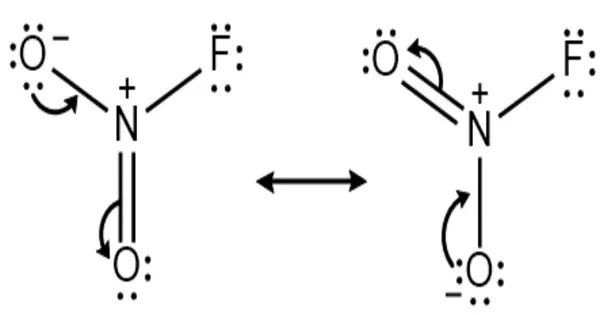
Nitryl fluoride is an inorganic, covalent chemical compound consisting of a nitrogen atom bonded to two oxygen atoms and one fluorine atom. It is a colourless gas and strong oxidizing agent, which is used as a fluorinating agent and has been proposed as an oxidiser in rocket propellants (though never flown). Its formula is NO2F. It is one of the most important nitryl compounds and serves mainly as a strong oxidizer and fluorinating agent in chemical synthesis.
It is a molecular species, not ionic, consistent with its low boiling point. The structure features planar nitrogen with a short N-F bond length of 135 pm.
Preparation
Henri Moissan and Paul Lebeau recorded the preparation of nitryl fluoride in 1905 by the fluorination of nitrogen dioxide. This reaction is highly exothermic, which leads to contaminated products. The simplest method avoids fluorine gas but uses cobalt(III) fluoride:
NO2 + CoF3 → NO2F + CoF2
The CoF2 can be regenerated to CoF3. Other methods have been described.
Properties
- Chemical formula: FNO2
- Molar mass: 65.003 g·mol−1
- Melting point: −166 °C (−267 °F; 107 K)
- Boiling point: −72 °C (−98 °F; 201 K)
- Solubility: Slowly hydrolyzes in water
Chemical Properties
- Oxidizing agent: Strong, due to the presence of the nitryl group.
- Fluorinating agent: Transfers fluorine to many organic and inorganic substrates.
- Reactive with water: Hydrolyzes to produce nitric acid (HNO₃) and hydrofluoric acid (HF).
- Unstable at higher temperatures: Decomposes to nitrogen dioxide (NO₂) and fluorine-containing species.
- Corrosive: Reacts with many materials, especially in moist air.
Natural Occurrence
Nitryl fluoride does not occur naturally in measurable quantities. Any formation is extremely rare and would likely involve atmospheric photochemical reactions involving nitrogen oxides and fluorine species, but such conditions are not naturally common.
Industrial or Laboratory Occurrence
It is typically synthesized through one of the following:
- Fluorination of nitrogen dioxide: NO₂ + F₂ → NO₂F
- Reaction of nitryl chloride with fluorides
- Halogen exchange reactions involving nitronium salts
Industrial-scale production is limited, because NO₂F is a specialty chemical mainly used in controlled environments.
Applications
Despite being a niche chemical, nitryl fluoride has several specialized uses:
A. Fluorinating Agent
- Used in organic and inorganic synthesis to introduce fluorine atoms.
- Useful in preparing fluorinated nitrates and nitro compounds.
- Helps convert oxides or chlorides to fluorides.
B. Oxidizing Agent
- Acts as a strong oxidizer in controlled chemical reactions.
- Used in laboratory-scale redox processes.
C. Rocket Propellant Research (historical/experimental)
- Studied as a potential component in oxidizers for rocket fuels, due to its high oxidative power.
- Its instability and corrosiveness limited practical use.
D. Surface Treatment / Plasma Chemistry
- In plasma-assisted processes, it helps create specific fluorinated surfaces or materials.
- Sometimes involved in semiconductor etching research.
E. Chemical Intermediate
- Helps prepare nitronium salts (NO₂⁺) or fluorinated nitrogen oxide compounds.
Safety Notes
- Highly corrosive and toxic.
- Can release HF on contact with moisture—extremely dangerous.
- Must be handled with specialized equipment under dry, inert conditions.