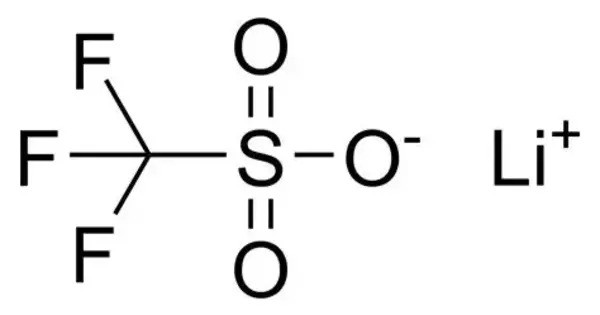
Lithium triflate (lithium triflouromethanesulfonate or LiOTf) is a salt with the chemical formula LiCF3SO3. It is a lithium salt of triflic acid (trifluoromethanesulfonic acid). It is composed of the lithium cation (Li+) and triflate anion (CF3SO3−; TfO−). It is very hygroscopic. The salt is used in lithium-ion battery production. It is widely used in electrochemistry, materials science, and high-performance solvent systems due to its excellent chemical stability and ionic conductivity.
Properties
- Chemical formula: CF3LiO3S
- Molar mass: 156.00 g·mol−1
- Appearance: White solid
Occurrences
Not naturally occurring. Lithium triflate does not exist in nature; it is a synthetic compound produced industrially or in laboratory settings.
Production/Preparation
Typically synthesized by:
- Neutralizing triflic acid (CF₃SO₃H) with lithium carbonate or lithium hydroxide, or
- Metathesis reactions involving silver triflate and lithium salts.
Applications
While not naturally found, it “occurs” widely in industrial and research contexts:
1. Lithium-Ion Batteries
- Used as an electrolyte salt due to high conductivity and thermal stability.
- Replaces LiPF₆ in some high-temperature or high-stability applications.
2. Polymer Electrolytes
- Incorporated into PEO, PMMA, and other polymer matrices to create solid-state electrolytes.
3. Catalysis
- Used in Lewis acid catalysis, e.g., in Friedel–Crafts reactions and rearrangements.
4. Organic Synthesis
- Useful as a stable, non-coordinating anion source.
- Employed in ionic liquids and phase-transfer systems.
5. Electrochemical Research
- Popular in supercapacitors, electrochromic devices, and ionic conduction studies.