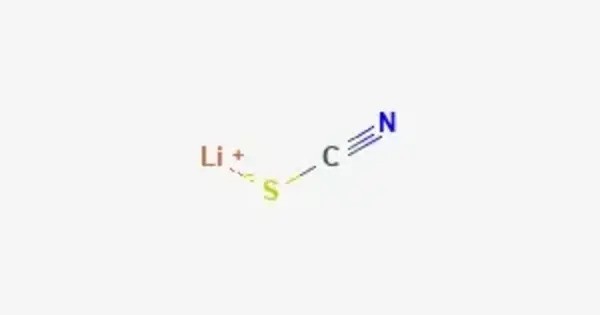
Lithium thiocyanate is a chemical compound with the formula LiSCN. It appears as a colorless to white crystalline solid and is highly soluble in water and alcohols. It is an extremely hygroscopic white solid that forms the monohydrate and the dihydrate. The compound is hygroscopic, meaning it readily absorbs moisture from the air, and must be stored in airtight containers. It is the least stable of the alkali metal thiocyanates due to the large electrostatic deforming field of the lithium cation.
Chemically, LiSCN is used in organic synthesis, particularly in introducing the thiocyanate group into organic molecules. It serves as a source of the SCN⁻ nucleophile in substitution reactions. Lithium thiocyanate is also used in the preparation of complex compounds and as an electrolyte in certain electrochemical applications, such as lithium-ion batteries and dye-sensitized solar cells.
Structure
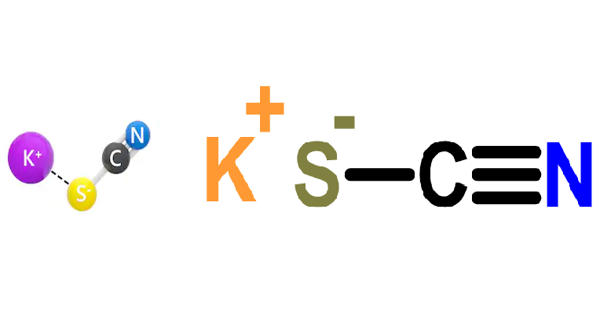
Its structure includes a linear SCN⁻ ion, with the sulfur and nitrogen atoms capable of coordinating with metal centers, making it useful in coordination chemistry. Unlike other alkali thiocyanates, lithium thiocyanate has unique solubility and conductivity properties due to the small size of the lithium ion.
Properties
- Chemical formula: LiSCN
- Molar mass: 65.02 g/mol
- Appearance: White hygroscopic solid
- Density: 1.44 g/cm3
- Melting point: 274 °C (525 °F; 547 K)
- Boiling point: 550 °C (1,022 °F; 823 K) (decomposition)
- Solubility in water: 125 g/100 ml
- Solubility: Soluble in alcohol
Preparation
Lithium thiocyanate is hygroscopic and forms the anhydrous, monohydrate, and dihydrate, which melts at 274, 60, and 38 °C, respectively. The monohydrate supercools after melting, as it recrystallizes at 36 °C. It is soluble in many organic solvents, such as ethanol, methanol, 1-propanol, and acetone. However, it is insoluble in benzene.
Due to its hygroscopicity, the anhydrous form is hard to prepare. The anhydrous form is usually prepared by the reaction of lithium hydroxide and ammonium thiocyanate, then the water was removed by vacuum, then the resulting solid was dissolved in diethyl ether, followed by adding to petroleum ether to form the ether salt, then it was heated in vacuum at 110 °C to result in the anhydrous salt. The overall reaction is the following:
LiOH + NH4SCN → LiSCN + NH4OH
The ether can be replaced by THF.
Occurrences
Lithium thiocyanate does not occur naturally in mineral form. It is a synthetic compound, typically prepared in laboratories or industrial settings. It is usually produced via neutralization reactions:
Synthesis: Reaction of lithium hydroxide (LiOH) or lithium carbonate (Li₂CO₃) with thiocyanic acid (HSCN) or ammonium thiocyanate (NH₄SCN).
LiOH + HSCN → LiSCN + H₂O
Li₂CO₃ + 2 HSCN → 2 LiSCN + CO₂ + H₂O
Because of its synthetic origin, lithium thiocyanate is not typically found in nature or in naturally occurring ores.
Applications
Though not as widely used as other lithium salts (e.g., lithium carbonate or lithium chloride), lithium thiocyanate has several niche and specialized applications, especially in chemistry and materials science:
(1) Electrolytes in Batteries
- Lithium thiocyanate has been explored as a component of electrolytes in lithium-based batteries, particularly for solid-state and polymer electrolytes.
- The SCN⁻ ion contributes to ionic conductivity and flexibility in polymer matrices like polyethylene oxide (PEO).
(2) Infrared Spectroscopy and Crystallography
- Used in infrared (IR) spectroscopy as a matrix or dispersant due to its transparency in certain IR regions.
- May be used to grow crystals for X-ray diffraction studies.
(3) Chemical Synthesis and Catalysis
- Acts as a thiocyanating agent in organic synthesis for introducing the –SCN group into molecules.
- Can be used in reactions requiring a soluble lithium source with nucleophilic properties.