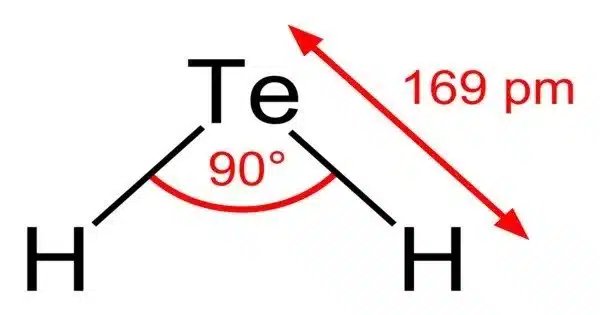
Hydrogen telluride is the inorganic compound with the formula H2Te. It is a binary hydride of tellurium and hydrogen, belonging to the chalcogen hydride group. A hydrogen chalcogenide and the simplest hydride of tellurium, it is a colorless gas. Although unstable in ambient air, the gas can exist long enough to be readily detected by the odour of rotting garlic at extremely low concentrations, or by the revolting odour of rotting leeks at somewhat higher concentrations.
H₂Te is weakly acidic in water but exhibits strong reducing properties, making it highly reactive with oxidizing agents. Due to its high toxicity and instability, hydrogen telluride has very limited practical applications. It is mainly used in controlled laboratory environments and in semiconductor research for depositing tellurium-containing thin films. Exposure to hydrogen telluride can cause severe respiratory irritation, neurological effects, and can be fatal at low concentrations.
Properties
It is a colorless gas with a very unpleasant odor and is extremely toxic. It is chemically unstable and decomposes readily at elevated temperatures or in the presence of light, forming elemental tellurium and hydrogen gas. It is heavier and less stable than its lighter analogues, hydrogen sulfide and hydrogen selenide.
- Chemical formula: H2Te
- Molar mass: 129.6158 g mol−1
- Appearance: colourless gas
- Odor: Pungent, resembles rotting garlic or leeks
- Density: 3.310 g/L, gas 2.57 g/cm3 (−20 °C, liquid)
- Melting point: −49 °C (−56 °F; 224 K)
- Boiling point: −2.2 °C (28.0 °F; 270.9 K) (unstable above −2 °C)
- Solubility in water: 0.70 g/100 mL
- Acidity (pKa): 2.6
- Conjugate acid: Telluronium
- Conjugate base: Telluride
Synthesis
Electrolytic methods have been developed. H2Te can also be prepared by hydrolysis of the telluride derivatives of electropositive metals. The typical hydrolysis is that of aluminium telluride: Al2Te3 + 6 H2O → 2 Al(OH)3 + 3 H2Te
Other salts of Te2− such as MgTe and sodium telluride can also be used. Na2Te can be made by the reaction of Na and Te in anhydrous ammonia. The intermediate in the hydrolysis, HTe−, can be isolated as salts as well. NaHTe can be made by reducing tellurium with NaBH4.
Hydrogen telluride cannot be efficiently prepared from its constituent elements, in contrast to H2Se.
H2Te is an endothermic compound, degrading to the elements at room temperature: H2Te → H2 + Te
Light accelerates the decomposition. It is unstable in air, being oxidized to water and elemental tellurium: 2 H2Te + O2 → 2 H2O + 2 Te
It is almost as acidic as phosphoric acid (Ka = 8.1×10⁻³), having a Ka value of about 2.3×10⁻³. It reacts with many metals to form tellurides.
Occurrence
Hydrogen telluride does not occur naturally in significant amounts due to its instability. It may be formed in trace quantities during the decomposition of tellurium-containing minerals or as a byproduct in certain metallurgical and industrial processes involving tellurium. In laboratories, it is typically prepared by reacting metal tellurides with acids.
Applications
Hydrogen telluride has very limited practical applications because of its high toxicity and instability. It is mainly used in laboratory research and analytical chemistry to study tellurium compounds and chalcogen hydrides. In some specialized semiconductor and materials research, it may be used as a precursor for tellurium-containing compounds, under strictly controlled conditions.