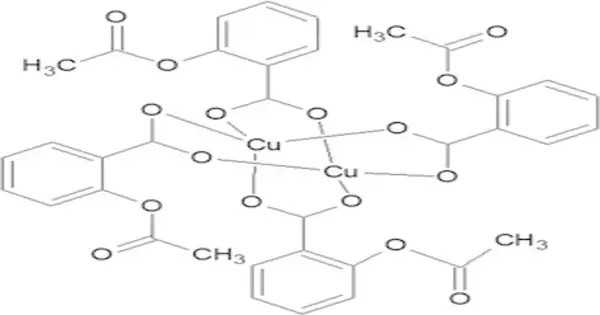
Copper(II) aspirinate is an aspirin chelate of copper(II) cations (Cu2+). It is used to treat rheumatoid arthritis. It is a paddle-wheel dinuclear coordination complex of copper(II) with four deprotonated aspirin (acetylsalicylic acid) ligands bridging two Cu²⁺ ions.
It is typically isolated as a tetranuclear paddle-wheel complex [Cu₂(asp)₄]₂ or as solvent-coordinated monomeric/oligomeric forms, but the classic dark-green crystalline form is the anhydrous quadruply-bridged Cu₂(acetylsalicylate)₄ dimer (similar to the well-known copper(II) acetate Cu₂(CH₃COO)₄·2H₂O).
Structure
Each copper center is square-pyramidal with four basal oxygen atoms from carboxylate groups of aspirin and one apical Cu–Cu interaction (Cu–Cu ≈ 2.61 Å); the acetylsalicylic acid is coordinated only via the carboxylate, leaving the ester intact.
Properties
- Chemical formula: C36H28Cu2O16
- Molar mass: 843.69g/mol
- Appearance: Bright blue crystalline solid.
- Melting point: 248 to 255 °C (478 to 491 °F; 521 to 528 K) (decomposes)
Preparation
Copper aspirinate can be prepared by several methods. In one route of preparation, an excess of acetylsalicylic acid is dissolved in aqueous sodium carbonate. Sodium hydroxide is not suitable for this purpose, because it will hydrolyse acetylsalicylic acid (ASA) into salicylic acid and sodium acetate.
2 HC9H7O4 + Na2CO3 → 2 NaC9H7O4 + CO2↑ + H2O
The resulting solution is then filtered to remove any undissolved acetylsalicylic acid and is mixed with a solution containing Cu2+ cations (copper(II) sulfate is suitable), precipitating bright blue crystals of copper aspirinate immediately. The crystals can then be filtered from solution, washed, and dried. An excess of acetylsalicylic acid is used in the first step, because it eliminates the possibility of unreacted carbonate anions precipitating the copper in this step.
4 NaC9H7O4 + 2 CuSO4 → C36H28Cu2O16↓ + 2 Na2SO4
Natural Occurrence
Copper(II) aspirinate does not occur in nature. Aspirin (acetylsalicylic acid) itself is a purely synthetic drug (first synthesized by Bayer in 1897). Therefore the copper complex can only be prepared synthetically.
Medicinal use
Copper aspirinate has been proven effective as a treatment for rheumatoid arthritis. A pharmacokinetic study in healthy human volunteers supports its enhanced efficacy as compared with aspirin. The studies on animal models suggest that copper aspirinate is very promising in treating against thrombotic diseases and it has all the prospects of success in becoming an antithrombotic drug that prevents and treats thrombotic diseases in humans.