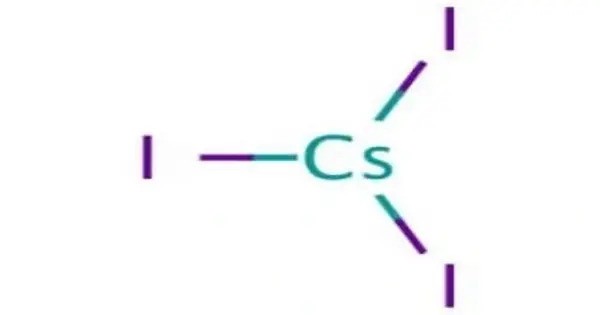
Caesium triiodide is an inorganic compound, with the chemical formula of CsI3. It typically forms as a dark brown to black crystalline solid and is stable in the solid state under dry conditions. It can be prepared by slow volatilization and crystallization of caesium iodide and iodine in aqueous ethanol solution. It can form precipitates with diazobenzene.
Caesium triiodide is mainly of scientific interest and is studied in solid-state chemistry, halogen bonding, and polyiodide structures. It undergoes a phase transition from Pnma to P-3c1 under high pressure, and its structure changes from layered to 3D. It also serves as a model compound for understanding iodine-rich materials, charge-transfer interactions, and the behavior of heavy alkali metal polyhalides.
Preparation
Caesium triiodide is usually prepared by reacting caesium iodide (CsI) with elemental iodine, allowing excess iodine to associate with iodide ions to form the triiodide species. The compound exhibits ionic bonding and shows good solubility in polar solvents where the I₃⁻ ion remains intact.
Properties
Caesium triiodide usually appears as a dark brown to black crystalline solid. It is composed of heavy caesium ions and linear triiodide ions, which give the compound strong light-absorbing properties. CsI₃ is generally stable under dry conditions but can be sensitive to moisture, where partial decomposition or iodine release may occur. It is more soluble in polar solvents than simple iodides due to the presence of the polyiodide ion.
- Chemical formula: CsI3
- Molar mass: 513.61886 g·mol−1
- Appearance: purple
- Melting point: 77 °C (decomposes)
Occurrences
Caesium triiodide does not occur naturally. It is synthesized in laboratories by reacting caesium iodide with elemental iodine under controlled conditions. Its formation is typical of alkali-metal polyiodides prepared for experimental and analytical purposes.
Applications
Applications of caesium triiodide are mainly research-oriented. It is used in the study of polyiodide chemistry, solid-state structures, and optical or electronic properties of iodine-rich materials. CsI₃ also serves as a reference compound in spectroscopy and crystallography and may have potential relevance in advanced optoelectronic or photonic research.