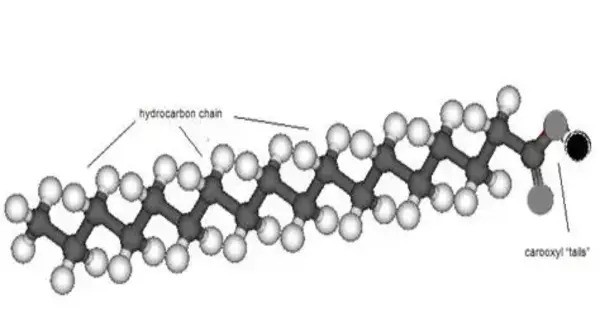
Silver stearate is a metal-organic compound with the chemical formula C18H36AgO2. It appears as a white or grayish-white powder, insoluble in water but soluble in organic solvents like benzene or chloroform. The compound is classified as a metallic soap, i.e. a metal derivative of a fatty acid (stearic acid). This compound forms through the reaction of silver nitrate with sodium stearate or stearic acid, producing a salt where silver ions are bonded to long-chain fatty acid anions.
Known for its hydrophobic and lubricating properties, silver stearate is used as a stabilizer, lubricant, and thickening agent in various industrial and laboratory applications. In plastics and rubber manufacturing, it improves processability and prevents degradation. Its antimicrobial and antifungal characteristics also make it valuable in coatings, textiles, and certain cosmetic formulations.
Properties
Silver stearate is a metallic soap formed from silver and stearic acid. It appears as a white to grayish fine powder, insoluble in water but soluble in organic solvents such as benzene, chloroform, and hot alcohol. It has a high melting point, typically around 165–180 °C, and exhibits good thermal stability. Silver stearate is known for its lubricating and anti-static properties, as well as its ability to form thin, uniform coatings. It also possesses mild antimicrobial characteristics due to the presence of silver ions.
- Chemical formula: C18H36AgO2
- Molar mass: 392.3
- Appearance: white powder
- Boiling point: 359.4 °C (678.9 °F; 632.5 K)
- Solubility in water: insoluble
Silver stearate forms white powder. The compound is insoluble in water, ethanol, diethyl ether. In electronics and photographic materials, silver stearate serves as a precursor for silver films or nanoparticles due to its ability to decompose into metallic silver upon heating. It is thermally unstable, decomposing to silver oxide or metallic silver at high temperatures. Although generally considered low in toxicity, it should be handled with care to avoid exposure to silver compounds. Silver stearate exemplifies the intersection of metal chemistry and organic fatty acid technology.
Synthesis
Silver stearate can be obtained by the reaction of sodium stearate and silver nitrate. Also by the reaction of stearic acid and silver nitrate in presence of DBU.
Occurrences and Preparation
Silver stearate does not occur naturally; it is produced synthetically by reacting silver nitrate with a soluble stearate (like sodium or potassium stearate). The compound is used in plastics, lubricants, and as a stabilizer or thickening agent. It also finds applications in coatings, photography, and specialty chemical formulations.