Potassium fumarate is a compound with formula K2C4H2O4. It is the potassium salt of fumaric acid. It is the potassium salt of fumaric acid, a naturally occurring organic compound involved in the Krebs cycle (cellular respiration). It appears as a white, odorless, crystalline powder that is highly soluble in water. It is generally regarded as safe (GRAS) when used appropriately. However, excessive intake could potentially disturb potassium levels, leading to hyperkalemia in sensitive individuals.
In the food and pharmaceutical industries, potassium fumarate is used as an acidity regulator, preservative, or buffering agent due to its stability and non-toxic nature. It may also be used in dietary supplements as a source of potassium and fumarate ions. It has E number “E366”. Its E number as a food additive is E366, though usage varies by region and regulatory approval.
Structure
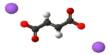
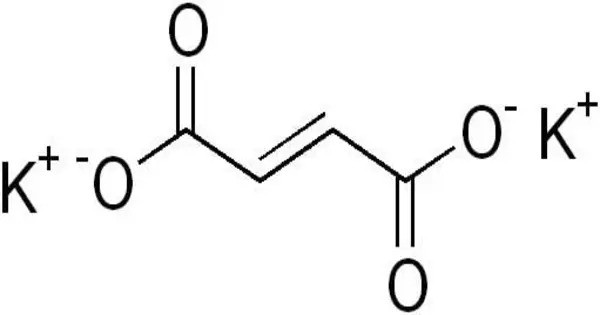
It is the dipotassium salt of fumaric acid, meaning both carboxylic acid groups are deprotonated and bonded to potassium ions. The fumarate ion has a trans (E) configuration around the double bond, making it more stable than its cis counterpart (maleate).
Properties
- Chemical formula: K2C4H2O4
- Molar mass: 192.253g/mol
- IUPAC Name: Dipotassium (E)-but-2-enedioate
- Appearance: White crystalline powder
- Solubility: Soluble in water
- pH (1% solution): Typically alkaline
- Stability: Stable under normal conditions
- Melting point: Decomposes before melting (as with many salts)
Biologically, fumarate is an intermediate in the citric acid cycle, essential for cellular energy production. Its potassium salt form may support electrolyte balance and acid-base homeostasis in the body. It is also of interest in industrial chemistry, where fumarate derivatives are used in resins, polymers, and surfactants. Though less common than sodium or calcium fumarate, potassium fumarate serves similar functions with the added benefit of supplying potassium.
Natural Occurrence and Production
Fumaric acid itself occurs naturally in many plants, fungi, and mammals as part of the Krebs cycle (citric acid cycle).
Potassium fumarate does not occur naturally in significant quantities — it is typically synthesized for industrial or laboratory use.
Industrial Production:
Produced by neutralizing fumaric acid with potassium hydroxide (KOH) in aqueous solution:
C4H4O4+2KOH→K2C4H2O4+2H2O
Uses and Applications
- Food industry: As a buffer or acidity regulator (E number may vary depending on region and formulation)
- Pharmaceuticals: Used in formulations for controlled pH and as a mineral supplement
- Research: As a biochemical reagent in metabolic studies involving the citric acid cycle