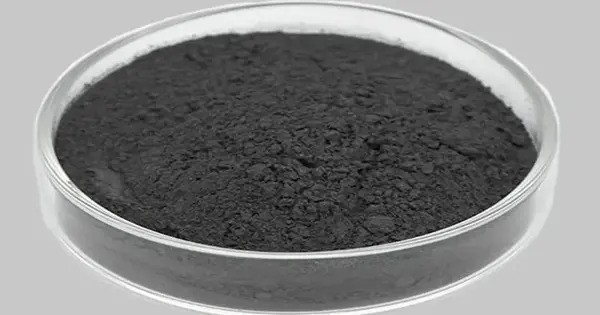
Lanthanum disilicide is a binary inorganic compound of lanthanum metal and silicon with the formula LaSi2. is an intermetallic compound made of lanthanum (La) and silicon (Si). Many other lanthanum silicides are known. It belongs to a family of rare-earth silicides valued for their electrical, thermal, and structural properties. LaSi₂ is especially noted in advanced materials research, electronics, and high-temperature applications.
Synthesis
Combine silicon and lanthanum powders, compress the mixture into solid blocks, and melt under vacuum conditions.
React lanthanum, silicon, and mercury in a quartz tube at 450 °C for 10–12 hours. Subsequently, eliminate surplus mercury through distillation, followed by annealing the resultant material at 450–600 °C.
1. Direct Reaction of Elements
- Heating lanthanum metal and silicon powder in a controlled atmosphere (argon or vacuum).
- High temperatures (≈1000–1500 °C) are required.
2. Solid-State Reaction / Arc Melting
- Arc furnace melting of La and Si in precise stoichiometric ratios.
- Followed by annealing to form a uniform phase.
3. Thin-Film Deposition for Electronics
- Using sputtering, evaporation, or chemical vapor deposition (CVD) on silicon wafers.
Properties
Lanthanum disilicide forms gray crystals. LaSi2 can exist in two crystal structures: tetragonal (α-GdSi2 type) and orthorhombic (α-ThSi2 type). The compound is known for its metallic behavior and various applications.
- Chemical formula: LaSi2
- Molar mass: 195.075 g·mol−1
- Appearance: gray crystals
- Density: 5.05 g/cm3
- Melting point: 1,500 °C (2,730 °F; 1,770 K)
Chemical properties
LaSi2 reacts with hydrochloric acid and hydrofluoric acid; insoluble in water.
Uses
The LaSi2-powder is characterized by high electrical resistivity, minimal thermal expansion, and outstanding thermal stability. These properties make it potentially useful for applications in electric heating devices, high-temperature sensors, refractory ceramics, thermal tools, and materials designed for efficient heat conduction. LaSi₂ is notable in specialized fields:
- Microelectronics: As a silicide contact material due to stable conductivity and compatibility with silicon substrates.
- High-temperature materials: Beneficial where both thermal stability and good electrical properties are needed.
- Thermoelectric research: Investigated for potential thermoelectric behavior.
- Materials science: Studied as part of the broader category of rare-earth silicides.
Safety & Handling
- Generally stable and non-toxic in solid form.
- Fine powders should be handled carefully due to reactivity at high temperature.
- Store in dry, inert conditions to avoid oxidation.