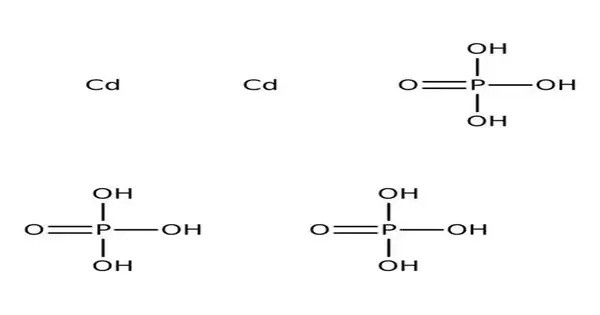
Cadmium phosphate is an inorganic phosphate salt of cadmium, with the molecular formula Cd3(PO4)2. It is a white, water-insoluble solid. In nature, it may occur as a rare mineral in phosphate-rich environments, though it is typically synthesized in laboratories. It is often produced by reacting cadmium salts, such as cadmium nitrate, with sodium or ammonium phosphate solutions.
Cadmium phosphate is mainly used in ceramics, glass, and pigments due to its ability to provide vivid colors and chemical stability. It also finds limited use in electronic components and phosphors for luminescent materials. Due to its hazardous nature, safer alternatives are now preferred in most commercial and industrial uses where cadmium phosphate was once common.
Properties
It appears as a white, crystalline solid that is insoluble in water but soluble in acids. The compound has a molecular weight of 543.21 g/mol and a density of about 5.8 g/cm³. It is thermally stable and decomposes only at high temperatures, releasing toxic cadmium fumes.
- Chemical formula: Cd3(PO4)2
- Molar mass: 527.18 g/mol
- Appearance: White solid
- Density: 5.17 g/cm3
- Melting point: 1,500 °C (2,730 °F; 1,770 K)
- Solubility in water: Insoluble
Synthesis
Tricadmium phosphate can be prepared by the reaction of cadmium chloride with diammonium phosphate at 800 °C:
3 CdCl2 + 2 (NH4)2HPO4 → Cd3(PO4)2 + 4 NH4Cl + 2 HCl
The precipitation of aqueous cadmium ions with soluble phosphate sources, such as trisodium phosphate and phosphoric acid, does not produce Cd3(PO4)2, but instead produces a hydrate of cadmium with the formula Cd5H2(PO4)4·4H2O. When this compound is heated, it yields a mixture of cadmium phosphate and cadmium pyrophosphate, Cd2P2O7.
Occurrences
Cadmium phosphate does not occur naturally in significant quantities. It is typically synthesized in laboratories or industrially by reacting cadmium salts (such as cadmium nitrate or cadmium sulfate) with phosphate sources (like disodium hydrogen phosphate). Trace amounts may appear in phosphate ores contaminated with cadmium.
Applications
Cadmium phosphate can be used as a fertilizer to provide phosphorus to crops for their growth. It has limited use because of cadmium’s toxicity. However, it has been employed in certain specialized applications, such as in the preparation of phosphor materials, pigments, and in laboratory research. It has also been explored in ceramics and glass manufacturing for color enhancement. Due to environmental and health concerns, its industrial use has been largely replaced by safer alternatives.