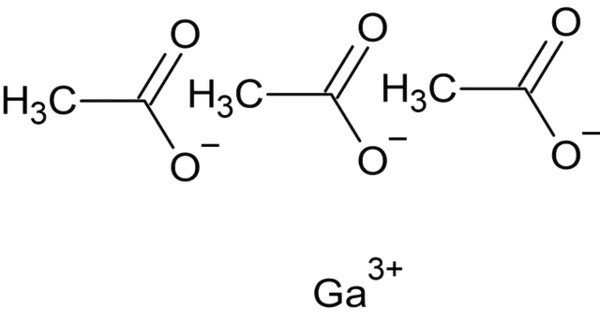
Gallium acetate is a salt composed of a gallium atom trication and three acetate groups as anions where gallium exhibits the +3 oxidation state. It has a chemical formula of Ga(CH3COO)3 although it can be informally referred to as GaAc[dubious – discuss] because Ac is an informal symbol for acetate. Gallium is moderately water-soluble and decomposes to gallium oxide when heated to around 70°C.
Gallium acetate, like other acetate compounds, is a good precursor to ultra-pure compounds, catalysts and nanoscale materials. Gallium acetate is being considered as a substitute in de-icing compounds like calcium chloride and magnesium chloride.
Structure
Gallium(III) acetate typically exists as a polymeric or oligomeric structure in the solid state, with acetate ligands bridging gallium centers. Gallium is octahedrally coordinated (Ga³⁺ prefers coordination number 6), so it often incorporates additional water or acetate oxygen atoms to satisfy coordination. In solution it hydrolyzes easily and forms various hydroxo- and oxo-species.
Properties
- Chemical formula: Ga(O2C2H3)3
- Molar mass: 246.85
- Appearance: white crystals
- Density: 1.57 g/cm/3
- Melting point: N/A
- Boiling point: 117.1C
Preparation
Gallium acetate can be formed using a neutralization reaction (acetic acid reacts with gallium oxide or gallium hydroxide):
6CH3COOH + Ga2O3 → 2Ga(CH3COO)3 + 3H2O
3CH3COOH + Ga(OH)3 → Ga(CH3COO)3 + 3H2O
Gallium can also be refluxed in acetic acid for several weeks to produce gallium acetate.
Synthesis
Reaction of gallium metal or Ga₂O₃ with hot glacial acetic acid + acetic anhydride (to remove water and drive reaction).
Ga₂O₃ + 6 CH₃COOH → 2 Ga(CH₃COO)₃ + 3 H₂O (anhydride scavenges water)
Reaction of GaCl₃ with sodium acetate in anhydrous conditions, followed by extraction.
Direct reaction of freshly precipitated Ga(OH)₃ with acetic acid.
Natural Occurrence
Gallium acetate does not occur naturally in any significant quantity. Gallium itself is never found as a free element in nature and occurs only in trace amounts (≈15–20 ppm in Earth’s crust), primarily as a minor substituent in aluminum minerals (bauxite, sphalerite, germanite, coal deposits). All gallium acetate is therefore synthetic.
Applications
It can also be used in conjunction with acetylacetonate bis(thiosemicarbazone) to create radiogallium-acetylacetonate bis(thiosemicarbazone) complex. It can be used in tumor imaging.
- Precursor for the preparation of high-purity gallium oxide (Ga₂O₃) thin films via sol-gel or CVD routes.
- Catalyst or catalyst precursor in organic synthesis (rarely used).
- Starting material for other gallium compounds.
Handling and Safety
- Strong irritant to eyes, skin, and respiratory tract because of acetic acid release on hydrolysis.
- Hydrolysis makes solutions corrosive.
- Not classified as highly toxic, but gallium compounds should be handled with care (gallium has moderate systemic toxicity; chronic exposure can cause skin rashes and bone marrow suppression).
- Store under inert atmosphere or in sealed containers to prevent slow decomposition by moisture and CO₂.