Long before humans built cities or wrote words, our ancestors may have faced a hidden threat that shaped who we became. Scientists studying ancient teeth found that early humans, great apes, and even Neanderthals were exposed to lead millions of years ago. This toxic metal can damage the brain, yet modern humans developed a tiny genetic change that protected our minds and allowed language and intelligence to flourish.
What made the modern human brain so different from that of our extinct relatives, such as Neanderthals? Researchers at the University of California San Diego School of Medicine, along with an international team, have discovered that ancient hominids, including early humans and great apes, came into contact with lead far earlier than previously believed – up to two million years before modern humans began mining it. This long-term exposure may have influenced how early brains evolved, possibly hindering language and social development in all but modern humans, who possess a unique protective genetic variant. The findings were published in Science Advances.
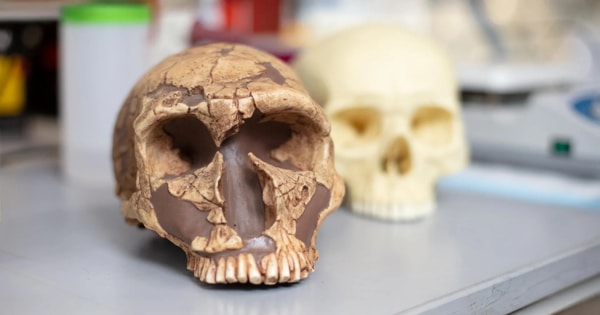
The team examined fossilized teeth from 51 hominids found across Africa, Asia, and Europe. The samples included both modern and archaic humans such as Neanderthals, early human ancestors like Australopithecus africanus, and extinct great apes including Gigantopithecus blacki.
Lead traces were present in 73% of the fossils studied, with 71% of modern and archaic human samples showing contamination. Fossils of G. blacki dating back 1.8 million years revealed the highest levels of acute exposure.
It was previously thought that humans began facing significant lead exposure only in recorded history, especially during the Roman era, when lead pipes were used for water systems, and later during the Industrial Revolution. Lead pollution declined only after the late twentieth century.
“We stopped using lead in our daily lives when we realized how toxic it is, but nobody had ever studied lead in prehistory,” said corresponding author Alysson Muotri, Ph.D., professor of pediatrics and cellular & molecular medicine at UC San Diego School of Medicine, associate director of the Archealization Center, and director of the Sanford Integrated Space Stem Cell Orbital Research Center.
One possibility is that they were looking for caves with running water inside. Caves contain lead, so they were all contaminated. Based on the tooth enamel studies, it started very early in infancy.
Alysson Muotri
To the researchers’ surprise, teeth from people born in the mid-twentieth century (the 1940s through the 1970s), when exposure to leaded gasoline and paint was widespread, showed similar lead patterns to ancient human fossils.
The scientists suggest that ancient humans and their relatives might have encountered lead through their search for water, much like the Romans did later in history.
“One possibility is that they were looking for caves with running water inside,” Muotri said. “Caves contain lead, so they were all contaminated. Based on the tooth enamel studies, it started very early in infancy.”
Lead exposure disrupts brain growth and function, impairing intelligence and emotional regulation.
Faced with this evidence, Muotri and his team began to question how modern humans managed to thrive despite such toxic conditions during their evolutionary past.
A tiny genetic change
A gene known as neuro-oncological ventral antigen 1 (NOVA1) plays a major role in brain formation and synaptic development. Acting as a key regulator of neurodevelopment, NOVA1 helps determine how neural progenitor cells react to lead exposure, and disturbances in its activity are linked to neurological disorders.
Nearly all modern humans carry a version of the NOVA1 gene that differs by a single DNA base pair from the version found in Neanderthals. Earlier work from Muotri’s group showed that swapping the modern NOVA1 with the older variant in miniature brain models, called organoids, caused dramatic changes in brain structure and connectivity.
“Everything about the organoids is identical except for that genetic variant, allowing us to ask whether that specific mutation between us and Neanderthals is giving us any advantage,” said Muotri. The archaic variant accelerated brain maturation but resulted in less complexity over time. “If all humans have this newer mutation in all corners of the world, very strong genetic pressure must have selected for it in our species.”
To test whether lead exposure might have shaped this genetic shift, the researchers created brain organoids with both the modern and ancestral NOVA1 variants, exposing them to lead and monitoring the growth of cortical and thalamic neurons.
They found that lead changed NOVA1 activity in both types of organoids, influencing genes linked to conditions such as autism and epilepsy.
However, only the archaic NOVA1 variant altered the activity of FOXP2, a gene crucial for speech and language. People with certain FOXP2 mutations struggle to form complex words and sentences.
“These type of neurons related to complex language are susceptible to death in the archaic version of NOVA1,” said Muotri. “ The FOXP2 gene is identical between us and the Neanderthals, but it’s how the gene is regulated by NOVA1 that likely contributes to language differences.”
Evolutionary implications
The findings suggest that the acquisition of the modern NOVA1 variant may have protected us from the detrimental effects of lead, promoting complex language development and social cohesion. This could have given modern humans a significant evolutionary advantage over Neanderthals, even in the presence of lead contamination.
Muotri believes these results have important implications for understanding how environmental stressors shaped brain development during human evolution. He speculates that lead exposure may have contributed to the extinction of Neanderthals around 40,000 years ago.
“Language is such an important advantage, it’s transformational, it is our superpower,” said Muotri. “Because we have language, we are able to organize society and exchange ideas, allowing us to coordinate large movements. There is no evidence that Neanderthals could do that. They might have had abstract thinking, but they could not translate that to each other. And maybe the reason is because they never had a system to communicate that was as efficient as our complex language.”
Understanding how NOVA1 gene variants can affect FOXP2 expression helps elucidate the relationship between lead contamination and brain development and also sheds light on neurological conditions related to language, including speech apraxia – a condition that makes it difficult to produce speech sounds correctly – and autism.